What is a Static Assessment
A static assessment is when we make observations and notes on how an animal stands. Ideally, we want the animal to stand square for this process, where all four limbs are positioned evenly underneath the body. This allows us to assess their posture and weight distribution more consistently and gives us a more accurate picture of how they naturally stand.
However, some animals are very reluctant to stand square, and this in itself can be an important observation. A reluctance to place a limb normally or maintain a square stance may indicate discomfort, although it is important to consider this alongside the rest of the assessment.
Weight Distribution
For example, if three limbs are standing square but one limb is placed laterally, further away from the body's midline, this may indicate an offload. By moving the limb further away from the midline, the animal can reduce the amount of weight being placed through that limb. This is something we may see in animals experiencing unilateral lameness.
It is also common to see horses, particularly those with hindlimb discomfort, position one hindlimb further behind or away from the body as part of an offloading strategy. As a result, we may also see the opposite limb positioned closer to the midline and more underneath the main mass of the body. This can allow the animal to place more weight through the opposite limb.
When an animal consistently places more weight through one limb to compensate for another, this altered loading pattern can potentially place additional stress on other structures over time. This is one of the reasons why identifying compensatory patterns is an important part of a physiotherapy assessment.
Body condition score
A body condition score (BCS) is a subjective assessment where we look at the animal as a whole to assess their body condition and the amount of fat they are carrying. We assess where fat is distributed across the body and whether the animal is carrying more or less body fat than would be considered appropriate for them.
When an animal is carrying excess body weight, this can affect the way they move and increase the physical demands placed on their musculoskeletal system. This can have implications for the loading of their limbs and joints, particularly when the additional weight is carried over a prolonged period.
In dogs, carrying excess body weight over an extended period can also have significant implications for their overall health and longevity. Research has demonstrated an association between maintaining a healthy body condition and increased lifespan in dogs.
This is also important when considering the weight carried by horses. Research by Dyson et al (2019) has demonstrated that an excessive rider-to-horse weight ratio can contribute to changes in movement, including temporary lameness. This highlights how additional weight can increase the physical demands placed on the musculoskeletal system.
On the other hand, an animal with a low body condition score may have reduced fat stores and, in some cases, reduced muscle mass. Fat itself is not a bad thing — animals need an appropriate amount of body fat to support normal health and provide an energy reserve. However, when an animal is not receiving enough energy or has insufficient energy stores, the body can begin to use other tissues as an energy source, including protein from muscle tissue. Prolonged inadequate nutrition can therefore contribute to muscle loss.
Having insufficient muscle mass can make it more difficult for an animal to perform their normal daily activities and maintain good postural support. Other muscles may then have to work harder to compensate, potentially increasing muscle tension and discomfort.
Body condition scores are commonly assessed using either a 1–5 or 1–9 scoring system. Each score has specific descriptions of what you would expect to see and feel when assessing an animal's body condition. This helps to standardise the assessment between practitioners. However, BCS remains a subjective assessment, meaning scores can vary slightly between individuals and practitioners.
As a veterinary physiotherapist, nutritional advice falls outside my scope of practice. Therefore, if your animal is scoring lower or higher than would be expected, I will always recommend seeking appropriate nutritional advice from your vet or a suitably qualified canine or equine nutrition professional.
Limb Alignment and Conformation
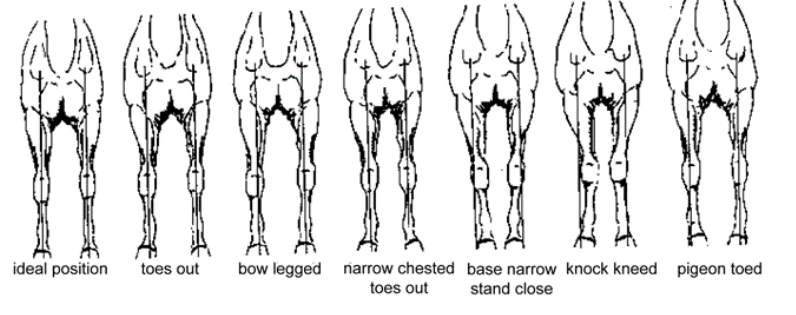
Another postural observation we make is the alignment and conformation of the limbs. Ideally, we want to see a relatively straight line of alignment through the limb, with the joints and distal limb positioned appropriately in relation to the body and the ground.
However, animals can naturally have differences in conformation that alter their limb alignment. Alternatively, an animal may actively alter its alignment or posture as a way of changing the forces placed through a particular joint or limb.
One example commonly seen in horses, particularly through the forelimbs, is external rotation. This is where the limb is rotated outwards away from the body's midline. When standing in front of a horse, this may be visible as the limb appearing rotated outwards, with more of the medial aspect of the limb becoming visible.
Rotational deviations can also be seen through the hindlimbs. For example, a horse may have external rotation of the hip, which can contribute to an inward orientation of the hocks. When both hocks are positioned closer together while the feet are further apart, this is commonly described as a cow-hocked conformation.
Limb alignment can also be affected lower down the limb, resulting in deviations such as pigeon-toed (toe-in) or toe-out positioning. These differences may be part of an animal's natural conformation, so they should not automatically be interpreted as a sign of pain or pathology. Instead, they are considered alongside the animal's movement, history and other assessment findings.
Muscle Mass
The final aspect we look at during a static assessment is overall muscle mass and symmetry.
We compare left to right, hindquarters to forequarters, and also assess the dorso-ventral muscle chain, essentially looking at the musculature along the top and underside of the animal's trunk.
If one limb appears to have less muscle mass than the other, this may indicate that the limb has been used less or has been consistently offloaded. Muscle asymmetry can therefore provide us with an important clue when combined with the animal's history and movement assessment.
In cases of bilateral forelimb lameness, for example, we may see reduced muscle development through the forequarters alongside relatively greater muscle development through the hindquarters. This can occur as the animal shifts its weight away from the forelimbs and towards the hindlimbs.
The Dorso-Ventral Muscle Chain
The musculature surrounding the trunk also gives us information about an animal's postural control and core strength.
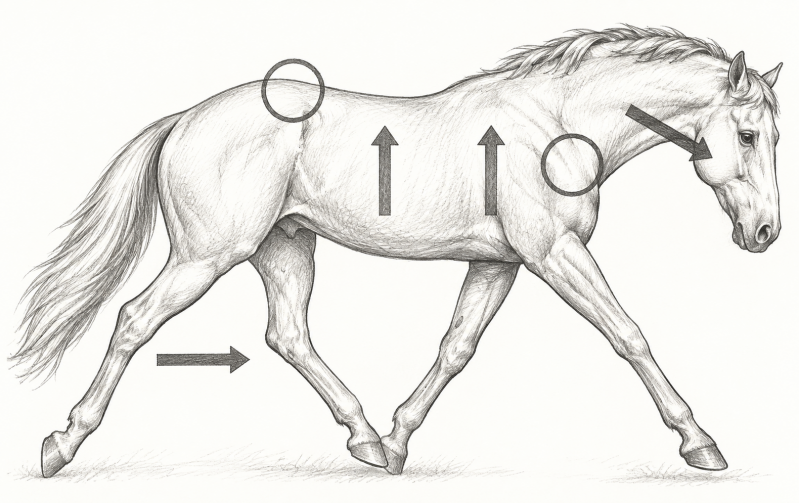
When there is reduced development or engagement of the muscles responsible for spinal stabilisation, we may observe a lordotic posture, where the spine appears to dip downwards through the back. It is important to distinguish this from true lordosis, which refers to an abnormal curvature of the spinal column itself. In this context, we are describing a postural change rather than diagnosing a spinal condition.
Posture can also be influenced by compensatory movement patterns. For example, horses experiencing forelimb discomfort, particularly bilateral forelimb discomfort, may adopt a higher head and neck position as part of an offloading strategy. Changes in head and neck position can influence the posture of the spine and the way the trunk musculature is recruited.
If this pattern is maintained over an extended period, reduced use of the postural and spinal stabilising musculature may contribute to reduced muscle development and strength.
The opposite postural pattern is a kyphotic posture, where the back appears more rounded or elevated. This can occur as part of a variety of compensatory patterns and may be observed in horses experiencing hindlimb or pelvic discomfort.
A good example is a prominent "hunter's bump", which can be associated with changes around the sacroiliac region, although its presence alone cannot be used to diagnose sacroiliac dysfunction. Similar changes in posture and muscle development can also be seen in dogs with conditions affecting the hindlimbs or pelvis, such as hip dysplasia.
Overall, a static assessment gives us a snapshot of how an animal is positioning and carrying its body at that moment. These observations are not diagnostic on their own, but when combined with the animal's history, movement assessment and palpation findings, they can help us build a much clearer picture of how the animal is moving and where compensatory patterns may be occurring.
General demeanour
Pain assessment is an important part of a veterinary physiotherapy assessment, particularly because our patients cannot tell us their pain level on a scale of one to ten. Instead, we have to learn how to interpret their behaviour and body language.
Pain assessment isn't something that is only carried out during the static assessment. It can be used throughout the entire treatment as a way of communicating with our animal patients and monitoring how they are responding to different aspects of the assessment and treatment. As soon as I greet a patient, I start looking for subtle changes in their behaviour and demeanour. For example, are they happy, alert and interested in their surroundings, as we would expect from that individual, or do they appear quieter, withdrawn or depressed? It is very important at this stage to ask the owner what is normal behaviour for their animal, because every animal is different. We never want to assume that a particular behaviour is abnormal without understanding what is normal for that individual.
We may observe whether the animal greets us at the door, approaches us willingly and interacts with their owner, or whether they remain withdrawn, stand in a corner, avoid interaction or hold their head lower than normal. These observations can provide useful clues about how the animal is feeling before we have even begun the physical assessment. In horses, observing vital signs is also important. We can look at their respiratory pattern and observe the rise and fall of the abdomen and ribcage. An abnormally increased respiratory rate or effort, particularly when the horse is at rest, may indicate that something is wrong and may require further veterinary investigation. As veterinary physiotherapists, it is important to recognise when a finding is outside our scope of practice and when veterinary attention may be required.
We can also use grimace scales to help assess pain. These are structured systems that look at specific changes in an animal's facial expression and body language. For example, the Horse Grimace Scale developed by Sue Dyson and colleagues assesses features including ear position, tension around the eyes and changes in the nostrils and muzzle. These can be subtle indicators that a horse may be experiencing pain or discomfort. Grimace scales should not be used in isolation, however. They are one piece of information that can be combined with the animal's behaviour, posture, movement, palpation findings and clinical history. Different species, and even individual animals, can display pain in very different ways. Dogs may show changes such as vocalisation, altered posture, reduced interaction, reluctance to move, changes in facial expression or attempting to move away when a painful area is approached. However, not all dogs will vocalise when they are in pain, so the absence of whimpering or crying does not mean that an animal is pain-free. This is why understanding the individual animal's normal behaviour is so important. Subtle changes can sometimes be more informative than obvious signs.
Ultimately, pain assessment is about putting together a number of different pieces of information. By continuously observing an animal throughout an appointment, we can better understand how they are feeling, identify potential areas of discomfort and monitor how they respond to our assessment and treatment.
Dyson, S., Ellis, A.D., Mackechnie‐Guire, R., Douglas, J., Bondi, A. and Harris, P., 2020. The influence of rider: horse bodyweight ratio and rider‐horse‐saddle fit on equine gait and behaviour: A pilot study. Equine Veterinary Education, 32(10), pp.527-539.
Add comment
Comments