Equine remedial exercise prescription can be made up of various different exercises, some can be conducted in the stable, some can be conducted while riding and some may involve ground work. My overall aim when prescribing exercises is to ensure we work towards our end goals and create a well rounded balanced horse.
The Bow and String Theory describes the relationship between the equine spine and core musculature. In this model, the bow represents the spinal column, a rigid framework supported by numerous ligaments and tendons, while the string represents the core musculature located beneath the spine. Contraction of the core musculature increases support for both the spinal column and the internal organs, encouraging lift and rounding through their back.
When a horse works with lift through its back, it is better able to step underneath itself with the hindlimbs, improving propulsion and weight-bearing capacity. This posture is also associated with a lower head carriage and reduced loading of the forehand, allowing more balanced, precise, and seemingly effortless movement. Such an outline is often considered desirable in ridden work to promote enhanced postural control.
When prescribing remedial exercises, development of core strength should remain central to the rehabilitation plan, as improvements in core stability can enhance posture, form and function.
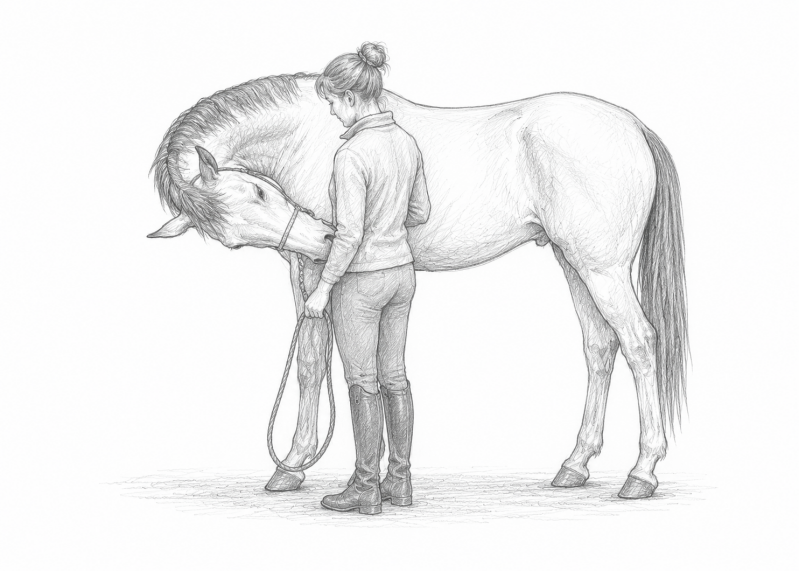
Static stretches
Static stretches come in many forms and can often be carried out after exercise or following a massage, usually in the comfort of the horse’s own stable. When muscles are warm, stretching can be more effective because it helps extend collagen fibres within the muscle (Smith, 2011). This may improve tissue function and support a greater range of motion within the joints (Frick, 2010).
Many horses develop areas of tension, particularly around the base of the neck and along the back. In these cases, carefully selected baited stretches can be very helpful in reducing muscle tightness and improving flexibility.
However, when prescribed incorrectly stretching exercises can cause more damage than good and therefore advice from a fully qualified vet physio is essential before completion.
Backing up
During backing up, the hamstring and gluteal muscle groups are targeted to help enhance hindlimb range of motion (Eldridge et al., 2025; de Oliveira et al., 2015). Additional benefits include a weight shift onto the hindlimbs, encouraging more weight to be carried through the hindquarters, coupled with a core contraction to enhance spinal stability (de Oliveira et al., 2015).
Finally, the increase in range of motion, together with improvements in hindquarter muscle strength over time, may help increase stride length (de Oliveira et al., 2015). Therefore, this exercise is very simple to perform, yet it has several advantages, benefiting not only hindquarter strength but also coordination, core strength, and overall posture.
Lunging
Lunging is very common within the equine industry. It is a useful way to evaluate how your horse is moving, a good fitness tool, and can also help enhance balance and spinal stability. Because lunging is performed on a circle, it encourages bending and flexion of the spine towards the inside of the circle, which may help improve mobility through the middle region of the back (van Wessum, van Weeren, & Greve, 2025).
Additional benefits include engagement of the core muscles, as the horse needs to maintain balance and coordinate its limbs while travelling on a circle (van Wessum, van Weeren, & Greve, 2025). When a horse has the appropriate muscle strength to maintain a relaxed long-and-low outline, lunging can be beneficial for encouraging a stretch through the top-line (van Wessum, van Weeren, & Greve, 2025).
The study by van Wessum, van Weeren, and Greve (2025) investigated lunging over a six-week period to see whether indicators of back pain improved. The researchers found improvements in muscle mass along the back and a reduced pain response during palpation. Lunging was not found to be more effective than exercise on an underwater treadmill; however, it was considered a much more accessible option for many owners (van Wessum, van Weeren, & Greve, 2025).
Although there are several listed benefits for lunging, including work on the bow and string theory, there are also several drawbacks. Lunging can make certain conditions such as tendon strains and arthritis worse. Additionally, when conducted too often can cause problems within itself. Therefore always ensure that lunging is completed along with advice from a fully qualified vet physio.
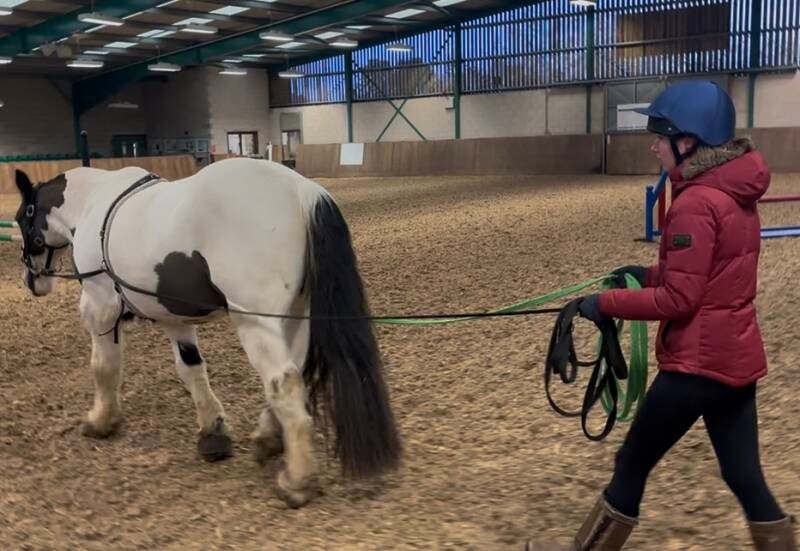
Long Lining
Long lining is probably my favourite remedial exercise. I often introduce it as a progression from in-hand walking, but it can be beneficial for many horses. Working the horse from behind encourages propulsion from the hindlimbs, helping activate important muscle groups such as the quadriceps and hamstrings. It also encourages a lowered head and neck position promoting spinal extension and core engagement, creating a more balanced and functional outline (Bromiley, 2007).Regular practice may help improve balance, coordination, muscle flexibility and joint mobility (Bromiley, 2007). Because the horse can be worked in straight lines, it is particularly useful during rehabilitation for conditions such as tendon strains, kissing spines and osteoarthritis. Long lining is not just for rehabilitation, though. I also find it a wonderful stretching and loosening exercise for the day after a competition, helping the horse move freely and comfortably without the weight of a rider.
Hill Work
Working up and down hills is something that can easily be added into your horse’s normal routine, whether that’s during a hack or while leading them in hand to and from turnout.
Walking uphill: When a horse walks up a hill, they naturally put more weight through their hindquarters (Castejón-Riber et al., 2017). To push themselves uphill, the hind legs take a longer stride and reach further behind the body, creating more power to move forwards (Crook, Wilson and Hodson-Tole, 2010). This helps strengthen the muscles around the hindquarters, particularly the hamstrings and quadriceps, while also encouraging the muscles along the back and core to work harder to support the spine (Castejón-Riber et al., 2017; Clayton, 2016). In simple terms, uphill work is a great exercise for building strength through the hindquarters and top-line.
Walking downhill: Walking downhill works the body slightly differently. The hind legs tend to step further underneath the horse, which helps strengthen the muscles that bring the leg forwards (Crook, Wilson and Hodson-Tole, 2010). Because the horse has to control their balance and slow themselves down, the core muscles work harder to stabilise the back (Crook, Wilson and Hodson-Tole, 2010). The front limbs also have to do more work, especially the chest and triceps muscles, to help support and control the movement downhill (Bromiley, 2007).
In terms of conditions, hill work is really beneficial for a wide variety of conditions. The most common condition to be prescribed hill work is upward fixation of the patella. This condition is normally associated with reduced strength of the quadriceps, so the increased range of motion hill work encourages helps develop this area of weakness. Additional conditions include kissing spines to help develop a better top-line and hock arthritis where increased hindlimb strength will help support vulnerable lower limb joints
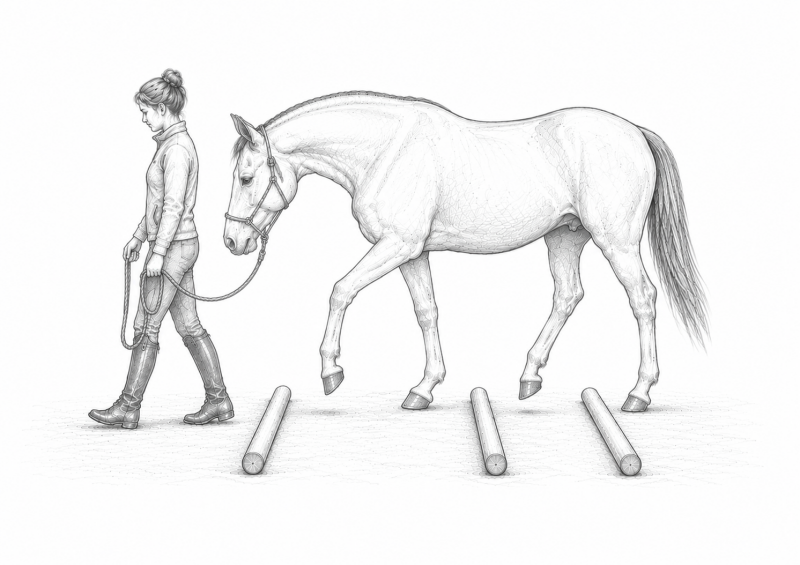
Pole Work
Pole work comes in various different shapes and sizes. We normally start with one ground pole, progressing to four poles, then to raised poles, and can progress further to weaves, star poles, hogs backs, and even a labyrinth. Each individual exercise targets a slightly different area; however, the main foundational benefits remain the same.
Ground poles can be used to help increase the range of motion and stride length of all four limbs, while also requiring recruitment of the spinal stabilisers within the back and core to help maintain postural stability (Shaw et al., 2021). Pole work requires the horse to balance on one diagonal pair (for example, the left hindlimb and right forelimb) while the opposite diagonal pair is in flight. This helps improve balance and coordination during movement and can be particularly beneficial for performance horses (Walker et al., 2022).
In order to maintain balance during pole work, the horse must recruit the muscles along the back and within the core, which provides additional support to the spinal column (Shaw et al., 2021). Referring back to the bow and string theory, pole work encourages increased range of motion so the limbs can step further underneath the body and take more weight. At the same time, it helps develop the core and topline musculature, supporting the development of a relaxed, long-and-low outline.
Final Thoughts
This is just a very simple summary of some of the remedial exercises that can be prescribed for various horses at various different levels of ability. These exercises are quick and easy to complete and many of them can be intregrated into your normal routines. Please head back over to my previous blog about the importance of remedial exercises and why its essential that they should be completed to the best of your abilities!
I will always try my best to set exercises that will help achieve yours and your horses end goals, as well as ensuring the routines fit well into your everyday life to make it as easy as possible to help reach your desired goals.
References
Bromiley, Mary. Equine Injury, Therapy and Rehabilitation, John Wiley & Sons, Incorporated, 2007.
Castejon-Riber, C., Riber, C., Rubio, M.D., Agüera, E. and Muñoz, A., 2017. Objectives, principles, and methods of strength training for horses. Journal of Equine Veterinary Science, 56, pp.93-103.
Clayton, H.M., 2016. Core training and rehabilitation in horses. Veterinary Clinics: Equine Practice, 32(1), pp.49-71.
de Oliveira, K., Soutello, R.V., da Fonseca, R., Costa, C., Meirelles, P.R.D.L., Fachiolli, D.F. and Clayton, H.M., 2015. Gymnastic training and dynamic mobilization exercises improve stride quality and increase epaxial muscle size in therapy horses. Journal of Equine Veterinary Science, 35(11-12), pp.888-893. DOI: https://doi.org/10.1016/j.jevs.2015.08.006
Eldridge, F., George, L.S., Chapman, M., Harrison, L., Tabor, G., Uttley, C. and Clayton, H., 2025. A comparison of equine hind limb muscle activation and joint motion between forward and backward walking. Journal of Equine Rehabilitation, p.100036. DOI: https://doi.org/10.1016/j.eqre.2025.100036
Frick, A., 2010. Stretching exercises for horses: are they effective?. Journal of equine veterinary science, 30(1), pp.50-59.
Shaw, K., Ursini, T., Levine, D., Richards, J. and Adair, S., 2021. The effect of ground poles and elastic resistance bands on longissimus dorsi and rectus abdominus muscle activity during equine walk and trot. Journal of Equine Veterinary Science, 107, p.103772.
Smith, R.K.W. 2011. Pathophysiology of tendon injury. In: Ross, M.W. and Dyson, S.J. ed. Diagnosis and management of lameness in the horse. 2nd ed. St. Louis: Saunders, pp. 694-706.
van Wessum, T., van Weeren, P. R., & Greve, L. (2025). Unridden exercise modalities for horses with back pain: A randomized clinical trial comparing water treadmill, dry treadmill, and lunging. BMC Veterinary Research, 21, Article 4950. https://doi.org/10.1186/s12917-025-04950-2
Walker, V.A., Tranquillle, C.A., MacKechnie-Guire, R., Spear, J., Newton, R. and Murray, R.C., 2022. Effect of ground and raised Poles on kinematics of the walk. Journal of equine veterinary science, 115, p.104005.
Add comment
Comments