Canine remedial exercise prescription is very versatile, with each exercise having a range of progressions to suit both injury recovery and performance enhancement. However, compared with horses, dogs can often be more strong-willed and, in my experience, if they do not want to do an exercise, they simply will not do it!
In general, some dogs are naturally better at certain exercises than others, and it is my job to work through that process of trial and error to find exercises that suit not only the dog, but also you as the owner. The aim is to create a programme that is practical, achievable, enjoyable for the dog, and aligned with your long-term goals.
Weight Shifting and Wobble cushions
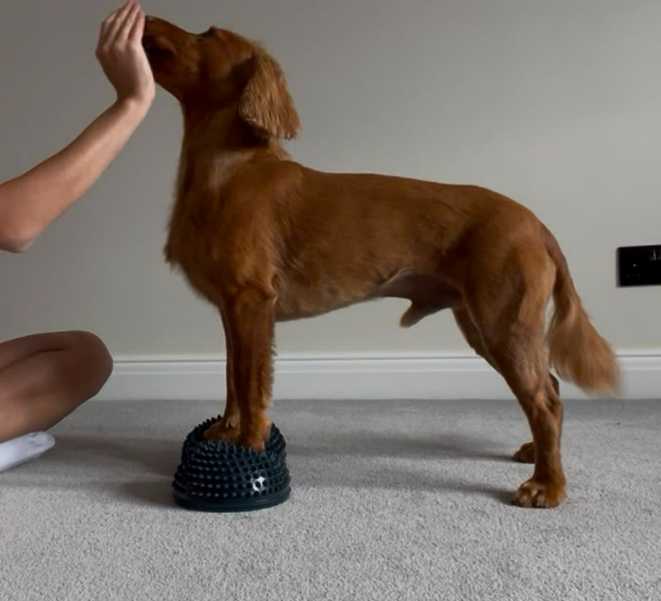
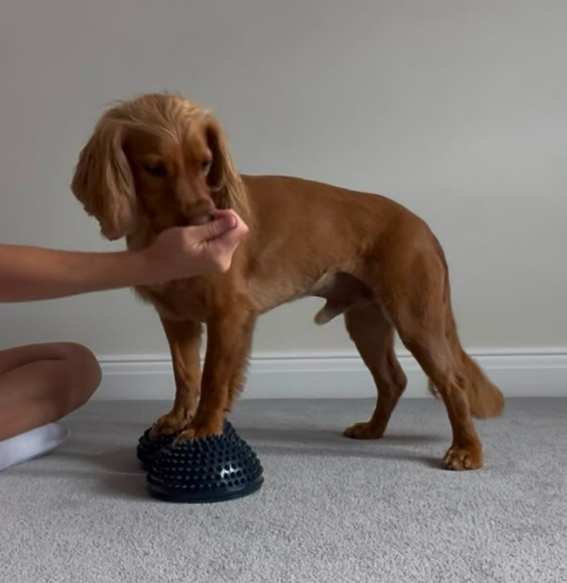
Weight shifting is a simple but very effective exercise that can be performed with most dogs, especially those in the early stages of a physiotherapy plan. A weight-shifting exercise is typically carried out with the dog standing square (all four limbs positioned an equal distance apart so that they would form a square if joined together). Using a treat to guide the dog’s head from one side to the other, we can encourage a side-to-side weight shift, and we can also incorporate a forwards and backwards shift (Dycus, Levine and Marcellin-Little, 2017).
The overall aim of this exercise is to promote even weight distribution between all four limbs, reduce compensatory movement patterns, and encourage dogs to load a previously injured limb. Evidence suggests that, although the effects on improving balance may be limited, this exercise can reduce pain associated with compensatory patterns and improve weight-distribution patterns so that each limb is loaded more evenly (Brantberg, Grooten and Essner, 2023). These exercises can be particularly beneficial for dogs undergoing physiotherapy for cruciate ligament disease or hip dysplasia, where loading the hindlimb may previously have been painful (Brantberg, Grooten and Essner, 2023).
Weight shifting can be progressed easily. For post-operative patients, we usually ensure that all four feet remain on the ground to help retrain even weight distribution and correct posture. However, when a wobble cushion is introduced under either the forelimbs alone or all four limbs, the exercise becomes much more challenging. A wobble cushion creates external perturbations that challenge stability (Physiopedia, n.d.). As a result, more core muscles are recruited to help maintain balance on the unstable surface (Ramos et al., 2025).
Some studies have shown that, even when wobble cushion exercises are compared with work on a hill, the wobble cushion alters the dog’s centre of balance to a greater extent. This suggests that wobble cushion weight shifts may be a beneficial exercise for performance dogs that would benefit from improved dynamic balance (Lutonsky et al., 2025).
Sit to Stand
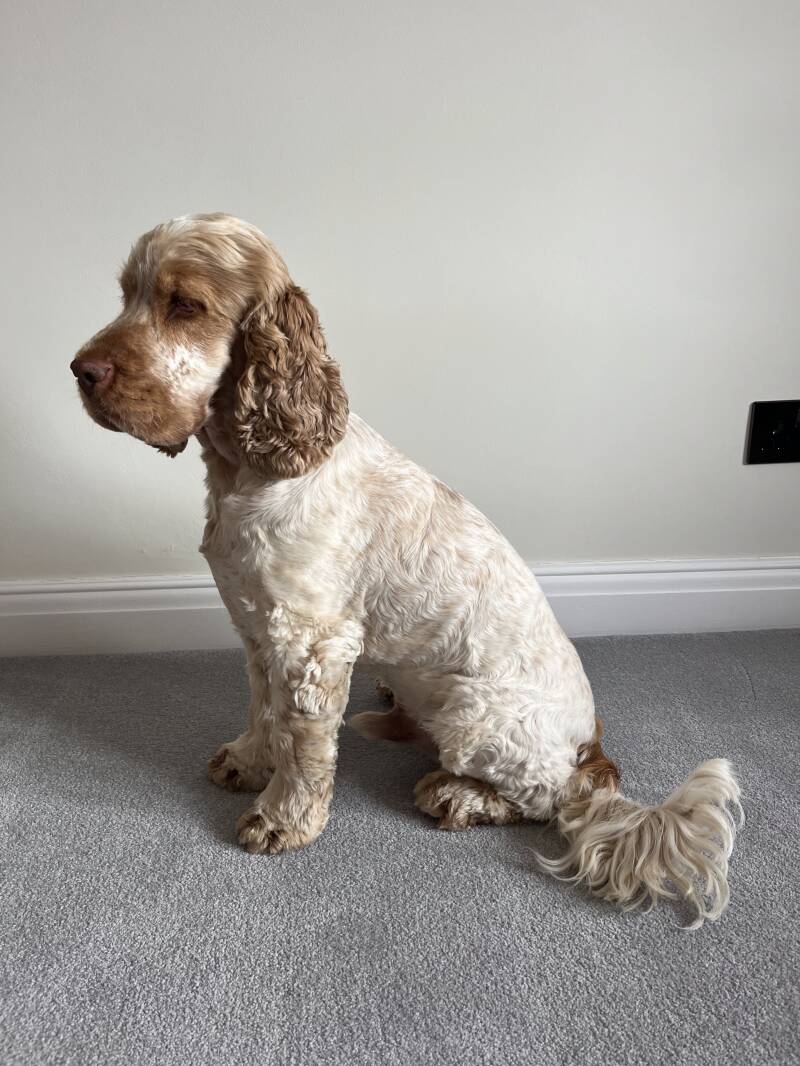
Sit-to-stands are common movements that dogs often perform on their own; however, therapeutic benefits arise when they are carried out repeatedly in succession. The aim of this exercise is to help strengthen the hindlimb muscles through controlled muscle contraction as the dog lowers itself into a sit, followed by activation of the joint extensor muscles to propel the hindquarters back into standing (Huntingford and Bale, 2024). Additionally, studies have shown that sit-to-stand movements expose the joints to very different ranges of motion compared with walking, particularly in the knees and ankles (stifles and tarsi). Therefore, this exercise can be useful for enhancing hindlimb range of motion (Yoshikawa et al., 2023).
When performing a sit-to-stand exercise, it is very important that the dog demonstrates correct form and function. This means the dog should sit square, which is demonstrated clearly in the associated image. Sitting square is when the hindlimbs are folded underneath the body with all joints aligned (Huntingford and Bale, 2024). This can be a challenging concept for weak or older dogs. Therefore, we can provide support to help them achieve the correct position, for example by using blocks to prevent splaying or by gently using our hands to guide them into alignment.
This exercise can be really beneficial for hindlimb conditions such as hip dysplasia, cruciate ligament rupture or helping older dogs maintain their toilet position. However, when conducted too early in the rehabilitation program can cause more damage, so always consult a qualified vet physio before conducted exercises.
Down to stand
Down-to-stands are a common progression from the sit-to-stand exercise and can be viewed as a “doggy press-up”. Just like the sit-to-stand exercise, although it is common for dogs to perform this movement naturally, it is only therapeutically beneficial when conducted repeatedly in succession.
The aim of this exercise is to ensure the dog is lying square, which can be seen in the photo to the right. The goal is for the dog to rise into a stand rather than pull itself into a stand. This means the feet should remain in the same position from the fully lying position through to the fully standing position. Maintaining this posture encourages the dog to use its core to lift itself rather than relying on the forelimbs to drag itself back up into standing. Evidence suggests that dogs performing a down-to-stand with correct posture may develop a stronger core, improve strength of the spinal stabilisers, enhance body awareness skills, and strengthen the hip stabiliser muscles (Farr, Ramos and Otto, 2020). Performing this exercise regularly may therefore help improve spinal stability and reduce repetitive stress on the spine, which is particularly important in performance dogs (Farr, Ramos and Otto, 2020).
Coupled with the evidence for sit-to-stands, down-to-stands will also enhance hindlimb range of motion, helping to increase hindlimb strength while simultaneously recruiting the core musculature to improve posture and stability.
The down-to-stand exercise can be progressed by performing it with all four limbs placed on a wobble cushion. This introduces an unstable surface and requires additional recruitment of the core musculature to maintain balance throughout the movement (Farr, Ramos and Otto, 2020).
Down-to-stands are often useful for dogs following cruciate ligament surgery, as well as working and performance dogs that require a strong core and enhanced limb stability.

Give paw
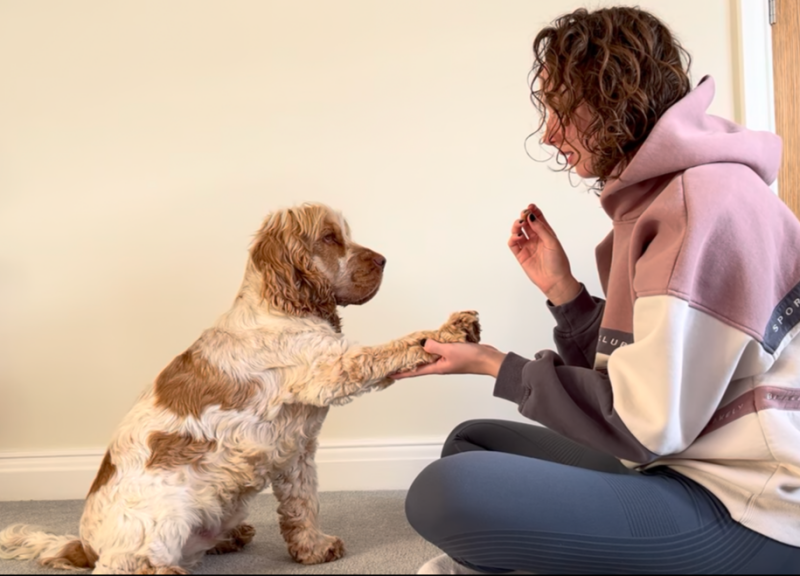
A give paw exercise is often a common part of many dogs’ everyday routines, and I’m sure you didn’t realise that it can also have strengthening benefits. In general, the dog requires an active contraction of the shoulder flexors, shoulder extensors, and elbow extensors (biceps and triceps) (Zink and Dyke, 2018) in order to lift the paw and then extend it forwards to give it to you. This works to enhance both shoulder and elbow strength and stability (Huntingford and Bale, 2024). Additionally, there is a weight shift onto the hindlimbs and the forelimb that remains in stance, activating the core and postural stabiliser muscles in order to maintain balance.
Give paw is an exercise that can be easily progressed. The main progression is asking the dog to give a paw at a higher level. We can also ask for a give paw while the dog’s front feet are placed on a raised block to enhance the backward weight shift. Finally, we can add a wobble cushion, starting with two feet on the cushion and progressing further so that all four feet are on the wobble cushion. This exercise is simple to perform at home, requires minimal equipment, and can be a useful addition to a strengthening programme when introduced gradually and tailored to the individual dog.
Cavetti
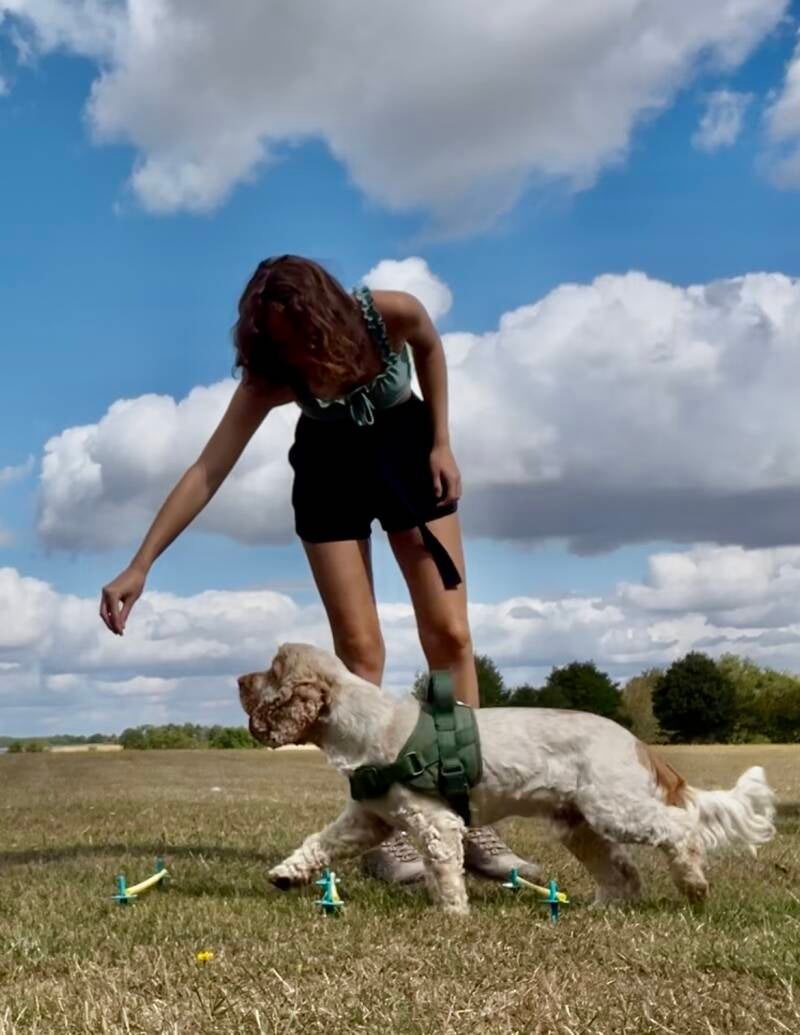
The same as with horses, cavaletti poles or ground poles come in many shapes and sizes. We can begin with poles low to the ground and gradually increase the height to make the exercise more challenging. Poles can also be used as a weaving exercise by placing poles between cones.
Cavaletti poles enhance coordination and body awareness skills, so they can be beneficial for neurological cases such as those with IVDD or Wobbler syndrome (Marcellin-Little, Levine and Taylor, 2005). Additional benefits include strengthening the limb flexor muscles and promoting an elongated stride length (Dyke, 2014).
The motion of stepping over poles targets muscles such as the biceps, shoulder stabiliser muscles (including the supraspinatus) (Mille, McClement and Lauser, 2022), as well as the quadriceps and gluteal muscles, aiding hindlimb strength and stability (Gamble, 2022). Therefore, this exercise can also be beneficial for performance dogs. Further benefits include an increased range of motion in the hindlimbs, specifically the knees and ankles (stifles and tarsi), as well as increased elbow flexion when compared with walking over flat ground (Holler et al., 2010).
The main benefits of cavaletti rails are to enhance body awareness, improve balance, and promote a longer stride length while working on hindlimb range of motion and forelimb flexion. Therefore, this exercise is not only beneficial for neurological cases but also for agility dogs, helping to increase muscle mass to support vulnerable structures exposed to repetitive strain and to promote greater propulsive power. Additional conditions that may also benefit include patellar luxation, where strengthening the quadriceps is desirable, and rehabilitation following biceps tendinopathy.
Back up and pivots/ sidestepping
Both of these exercises are used to help the body with balance and self-awareness of where the body is in space. However, additional benefits of backing up include strengthening of the hindlimbs, whereas side-stepping helps to improve strength and stability of both the forelimbs and hindlimbs (Huntingford and Bale, 2024).
Backing up reverses the functional demands of forward walking, recruiting muscles such as the gluteals, hamstrings, quadriceps, and biceps to a greater extent. This, in turn, enhances body awareness skills and neuromuscular pathways (Farr, Ramos and Otto, 2020; Zink and Van Dyke, 2018). Associated equine studies have found that backing up increased hindlimb range of motion and pelvic stabilisation, indicating that this exercise may help build postural stability, which is beneficial for weak dogs as well as performance dogs (Jobst, Zsoldos and Licka, 2024). Backing up is an exercise that specifically targets hindlimb strength and can be highly beneficial for dogs undergoing patellar luxation rehabilitation.
There is very little evidence related to side-stepping and pivoting; however, theoretical claims suggest that they may be beneficial for improving limb stability, particularly in performance dogs where prevention of limb splaying is desirable. Limited research suggests that pivoting is a progression from work in normal straight lines and may help increase balance capabilities by targeting the core and both forelimb and hindlimb stabiliser muscles (Robertson and Mead, 2013). Additional studies have found that pivoting may help increase strength of both the quadriceps and hamstrings, helping to keep the joints of the hindlimb properly aligned (Farr, Ramos and Otto, 2020).
These are the types of exercises that I commonly prescribe to canine athletes, as they help develop limb stability and postural control, two important areas to target during performance enhancement programmes. They can also be integrated into other rehabilitation programmes; however, caution should always be taken to ensure that the dog is at the appropriate stage of healing and progression before they are implemented.
Final Thoughts
This is a small selection of the many exercises that can be included in a dog’s remedial exercise prescription programme. Compared with horses, dogs are often much more versatile, and we understand that not every exercise will suit every dog.
Before carrying out any remedial exercises, please ensure that you seek advice from a qualified veterinary physiotherapist regarding the appropriate repetitions and whether the exercises are suitable for your dog, particularly if your dog has a pre-existing condition.
As always, I make it my mission to provide a tailored exercise plan that suits both your lifestyle and your dog’s lifestyle, while always keeping your individual goals in mind. My aim is to help you achieve those goals as quickly as possible, but above all, as safely as possible.
References
Brantberg, I., Grooten, W.J. and Essner, A., 2023. The effect of therapeutic exercise on body weight distribution, balance, and stifle function in dogs following stifle injury. Animals, 14(1), p.92.
Dycus, D.L., Levine, D. and Marcellin-Little, D.J., 2017. Physical rehabilitation for the management of canine hip dysplasia. Veterinary Clinics: Small Animal Practice, 47(4), pp.823-850.
Dyke, J.V., 2014. Therapeutic exercise in veterinary rehabilitation.
Farr, B.D., Ramos, M.T. and Otto, C.M., 2020. The penn vet working dog center fit to work program: a formalized method for assessing and developing foundational canine physical fitness. Frontiers in veterinary science, 7, p.470. DOI: https://doi.org/10.3389/fvets.2020.00470
Gamble, L.J., 2022. Physical rehabilitation for small animals. Veterinary Clinics: Small Animal Practice, 52(4), pp.997-1019.
Holler, P.J., Brazda, V., Dal-Bianco, B., Lewy, E., Mueller, M.C., Peham, C. and Bockstahler, B.A., 2010. Kinematic motion analysis of the joints of the forelimbs and hind limbs of dogs during walking exercise regimens. American journal of veterinary research, 71(7), pp.734-740.
Huntingford, J.L. and Bale, J., 2024. Therapeutic exercises part 1: land exercises. Physical Rehabilitation for Veterinary Technicians and Nurses, pp.357-379.
Jobst, I.D., Zsoldos, R.R. and Licka, T.F., 2024. Trunk kinematics and limb movement of horses walking backwards and forwards in hand and lifting a single limb. The Veterinary Journal, 306, p.106202. DOI: https://doi.org/10.1016/j.tvjl.2024.106202
Lutonsky, C., Affenzeller, N., Aghapour, M., Wegscheider, J., Peham, C., Tichy, A. and Bockstahler, B., 2025. Improving postural stability through proprioceptive training in dogs. Frontiers in Veterinary Science, 12, p.1645875.
Marcellin-Little, D.J., Levine, D. and Canapp Jr, S.O., 2007. The canine shoulder: selected disorders and their management with physical therapy. Clinical Techniques in Small Animal Practice, 22(4), pp.171-182. DOI: https://doi.org/10.1053/j.ctsap.2007.09.006
Mille, M.A., McClement, J. and Lauer, S., 2022. Physiotherapeutic strategies and their current evidence for canine osteoarthritis. Veterinary sciences, 10(1), p.2. DOI: https://doi.org/10.3390/vetsci10010002
Physiopedia (n.d) Perturbation- based balance training. Avaliable at: Perturbation-Based Balance Training - Physiopedia (assessed 14.1.2026)
Ramos, M.T., Otto, C.M., Richards, J. and Levine, D., 2025. The effect of progressively unstable equipment used in canine fitness and rehabilitation on standing postural control and muscle activity. Veterinary and Comparative Orthopaedics and Traumatology.
Robertson, Julia, and Andy Mead. Physical Therapy and Massage for the Dog, Taylor & Francis Group, 2013.
Yoshikawa, K., Kitazawa, T., Sano, T., Ino, T. and Miyasaka, T., 2023. Kinematic characteristics of canine hindlimb movement during sit-to-stand and stand-to-sit motions. Research in Veterinary Science, 162, p.104944.
Zink, C. & Dyke, J. B. V. (2018) Canine Sports Medicine and Rehabilitation. 2nd ed. John Wiley & Sons, Inc
Zink, C, & Van, DJB (eds) 2018, Canine Sports Medicine and Rehabilitation, John Wiley & Sons, Incorporated, Newark. Available from: ProQuest Ebook Central. [27 February 2026].
Add comment
Comments