Pole work is something that is closely associated with equine athletes; however, there are also so many benefits for both canine athletes and companion animals.
A simple set of poles can be challenging for dogs to articulate, especially my dogs, who seem to think the correct way to complete pole work is simply to kick the poles out of the way and pretend they don’t exist! However, when performed correctly and using appropriate equipment, this exercise requires engagement of much of the musculoskeletal system. It is a highly versatile exercise that can be incorporated into rehabilitation plans, neurological reconditioning, and strength and conditioning programmes, meaning it can be adapted to suit a wide range of dogs and their individual needs.
Straight poles
Initially, in rehabilitation, we start with the poles as low to the ground as possible and gradually progress by increasing their height. To begin with, the aim is to help develop limb awareness and promote neuromuscular connections, enhancing coordination and proprioception. In order to accurately articulate over the poles, the dog must actively engage its core muscles to support its spinal stability and body weight while lifting and manoeuvring each individual limb over the poles.
As the height of the poles increases, there is greater activation of the core musculature, alongside an increased demand for range of motion within each individual limb. Therefore, pole work can provide a range of therapeutic benefits. However, as pole height increases, there are also greater upward ground reaction forces acting on the limbs and changes in the dog's posture. This means that higher poles are not necessarily better, and the height should be selected according to the individual dog's ability and rehabilitation goals (Clarke et al., 2024).
Research has demonstrated that pole work can enhance awareness of limb position in space, helping to improve coordination (Marcellin-Little, Levine and Taylor, 2005). It can also strengthen the muscles involved in limb flexion (Dyke, 2014), as the dog must actively flex its limbs to clear the poles. This can involve muscles such as the supraspinatus and biceps, which contribute to shoulder stability and limb movement (Mille, McClement and Lauser, 2022).
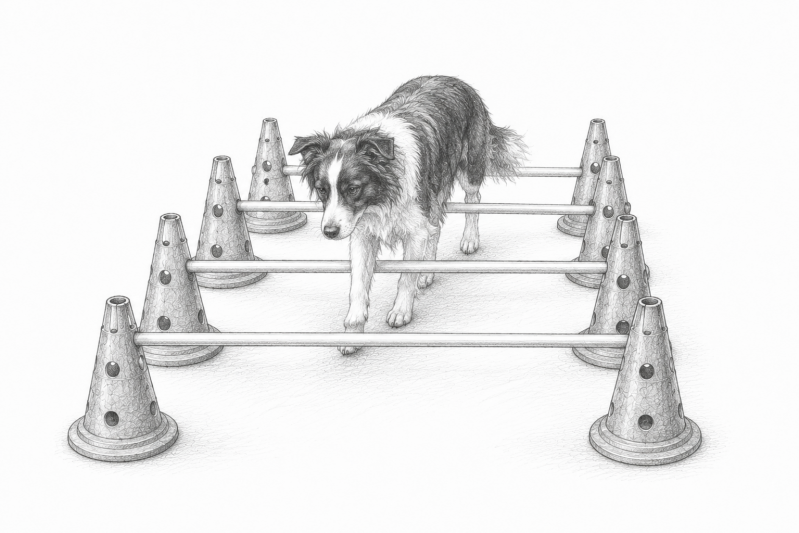
With pole work offering benefits such as improved proprioception and coordination, alongside strengthening the core musculature, shoulder stabilisers and limb flexors, it can be a highly beneficial exercise for a wide variety of canine companions.
For example, pole work can be incorporated into rehabilitation programmes for canines with neurological conditions, such as intervertebral disc disease (IVDD) and Wobbler syndrome, with the aim of improving limb awareness, coordination and muscle strength. Other conditions that may benefit from appropriately prescribed pole exercises include luxating patella, cruciate ligament injuries and sporting injuries such as biceps tendinopathy and supraspinatus tendinopathy.
As well as its use in rehabilitation, pole work can also be incorporated into prehabilitation and conditioning programmes to develop the strength and control of structures that may be vulnerable to repetitive strain. Improving muscular strength alongside balance, coordination and range of motion may help prepare canine athletes for the physical demands of activities such as sprinting and jumping. However, pole work should always be appropriately progressed and tailored to the individual dog, particularly when working with an existing injury or neurological condition.
Scatter poles
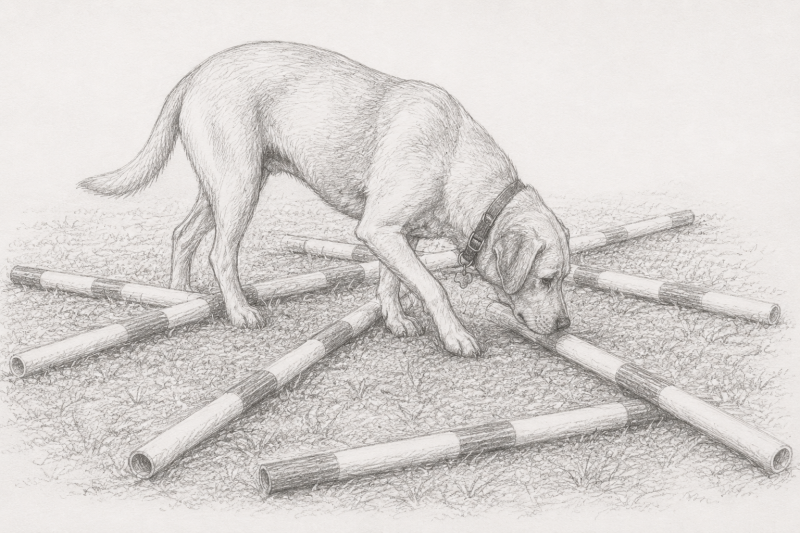
Scatter poles are a really useful exercise to encourage dogs to think about where they are placing their feet, making them particularly beneficial as part of neurological rehabilitation. By navigating poles placed at different angles and distances, dogs are encouraged to use their proprioception — their awareness of where their body and limbs are in space — while also challenging their neuromuscular coordination.
Additional benefits include encouraging an increase in range of motion, similar to traditional ground poles, while also challenging dynamic balance and core activation. As the dog has to take different step lengths and adjust their foot placement with each step, they are required to engage their core and postural muscles to help maintain their balance. This can be particularly beneficial for dogs with spinal conditions, such as IVDD or lumbar pain, where improving trunk and core control can help support overall stability.
Scatter poles can also be easily progressed as the dog becomes more confident. For example, some sections of the pattern can be raised, or the scatter poles can be incorporated into a proprioceptive track. These progressions provide additional challenges for balance, coordination and proprioceptive feedback, encouraging the dog to adapt to changes in their environment.
As with any pole exercise, scatter poles can increase the physical demands placed on the limbs and joints. They should therefore be avoided or appropriately modified where there is active swelling or inflammation, or where the exercise is unsuitable for a dog with significant osteoarthritis. As always, exercises should be selected and progressed according to the individual dog's condition, ability and stage of rehabilitation.
Proprioceptive Track
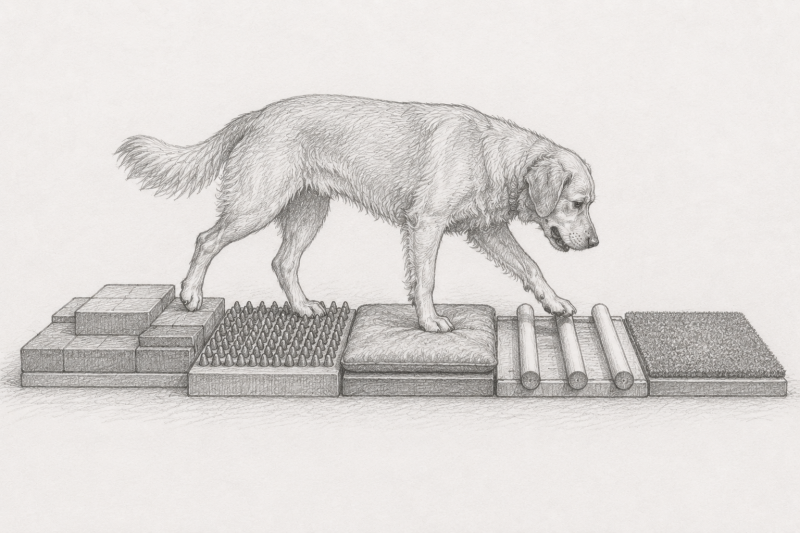
A proprioceptive track is created by gathering materials with a variety of different textures and encouraging the dog to walk over them. The overall aim is to provide different types of proprioceptive feedback to the brain, helping to improve neuromuscular coordination, particularly following neurological conditions.
When walking over different surfaces, such as textured, soft or spongy materials, the sensation felt through the dog's paw pads will change. This information is then sent to the brain, encouraging the dog to become more aware of where their limbs are and how they are placing their feet. This can help support the development of conscious limb control and more accurate foot placement.
Additional benefits can be seen when dogs walk over softer or cushioned surfaces. As these surfaces are less stable than a solid floor, they can challenge the dog's balance and require additional activation of their core and postural muscles to maintain their posture. This can therefore help to improve dynamic balance and body awareness.
This exercise can be progressed in many different ways. For example, we can use different surfaces underneath scatter poles to further increase the proprioceptive challenge. We can also add raised sections, such as stepping up and down from a sponge block. Not only does this encourage the dog to think about where their feet need to be placed for their next step, but it also requires an increased range of motion to flex the limb onto the block, followed by active engagement of the limb extensor muscles to help lift the body onto it.
A proprioceptive track can also be easily created at home using various everyday household items. For example, you could use a rough doormat, a sofa cushion, broom poles, a yoga block or even grass. The overall aim is to provide the dog with different sensations under their feet, encouraging them to think about how each surface feels and where they are placing their limbs.
This exercise can be made as simple or as complex as you want it to be, making it potentially beneficial at different stages of the rehabilitation process. However, if a dog is on strict crate rest, a proprioceptive track should not be advised unless specifically recommended by an appropriate rehabilitation professional.
Weaving
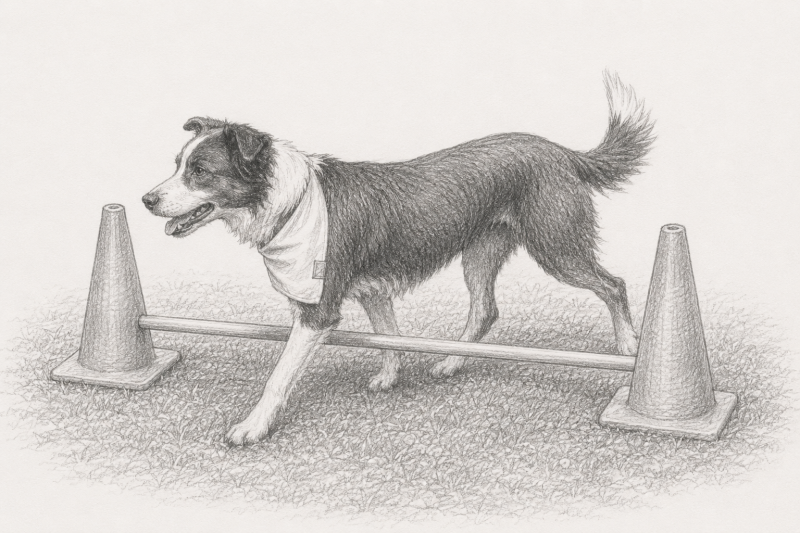
Weaving can be performed using two cones and a pole in a figure-of-eight, as the image to the left suggests, or with several cones and poles placed in a long line, weaving between them. Any weaving exercise should initially be performed with the poles on the ground and gradually progressed by raising them, following the advice of your veterinary physiotherapist.
The overall aim of this exercise is to enhance single-limb loading, with a lateral weight shift onto the limb in stance while the other limb is in flight. This can help to challenge limb stability and joint control by strengthening the muscles that pull the limb closer to the body (adductors) and those that pull the limb away from the body (abductors). This can be particularly beneficial for working and sporting dogs, such as agility or flyball dogs, where good lateral stability and body control are important.
Additional benefits include encouraging flexion and lateral movement through the spine, alongside increased core engagement as the dog bends through their body to weave between the poles. This can be particularly useful for agility dogs, as good spinal mobility and trunk control are important when performing movements such as weave poles, seesaws and tunnels.
Weaving also requires proprioceptive input and limb coordination, challenging the dog to accurately place each limb while navigating the pattern. This can help to improve overall balance, body awareness and movement coordination. As we begin to raise the poles, the exercise becomes more challenging, requiring the dog to maintain their spinal flexibility while also increasing their limb range of motion enough to clear the poles. This further challenges the limb flexor and extensor muscles, alongside increased core engagement to help the dog maintain balance and appropriate posture while stepping over the raised poles.
Personally, I would not typically integrate weaving into the early stages of a rehabilitation plan. Instead, I would consider it more appropriate further down the line as a strength and conditioning exercise, particularly for prehabilitation and performance enhancement once the dog has developed an appropriate level of strength, mobility and coordination.
Pivoting
Pivoting is another exercise that is more commonly used in strength and conditioning due to the high demands of the exercise itself. Before introducing this exercise, we want to ensure the dog is comfortable moving through the required range of motion to help reduce the risk of injury or re-injury.
Pivoting can be performed on the hindlimbs, as demonstrated in the image sequence below, or on the forelimbs while the hindlimbs remain stationary, making this a versatile exercise. This exercise challenges the abductors and adductors of both the fore and hindlimbs, as discussed with weaving. However, pivoting generally demands a greater level of recruitment from these muscles, making it a good progression from exercises such as weave poles. By strengthening the abductor and adductor muscles, we can help improve limb control and joint stability. This can be particularly useful for sporting or working dogs, where good lateral stability and limb control are important for reducing excessive limb splaying and supporting shoulder stability.
While pivots do not require a large amount of lateral spinal bending, as we want to maintain a relatively straight and neutral spine for good form and function, the exercise does require abdominal muscle engagement to help maintain postural stability. This movement pattern is not commonly performed during a dog's everyday activities, so it can provide a challenge that encourages them to think about their coordination, proprioception and overall limb awareness.
As the dog maintains a neutral spinal posture during the exercise, there is also active engagement of the muscles surrounding the pelvis to help maintain pelvic stability. Incorporating movement patterns outside of normal straight-line exercise can therefore provide an additional challenge for the pelvic stabilising muscles and contribute to improved hindlimb strength and control. This can be particularly useful for sporting dogs where good hindlimb strength and control are important for activities such as sprinting, jumping and weaving.
This exercise can be easily progressed by placing the stationary limbs on a block, increasing the load placed through the pivoting limbs. Alternatively, poles can be arranged in a fan pattern to encourage an increased range of motion while pivoting. A more advanced variation involves placing the stationary paws on a block while asking the dog to pivot and simultaneously step up and over additional blocks. As previously discussed, pivoting can be a challenging exercise and should only be introduced when the dog has developed an appropriate level of strength, coordination and fitness, with progression guided by your veterinary physiotherapist.
Due to the additional demands and loading placed on the limbs, pivoting may not be appropriate for dogs with active tendon or ligament injuries, as excessive loading could place additional strain on healing soft tissues. Other considerations include dogs in the early stages of CCL rehabilitation or those with severe elbow or hip dysplasia, where these more demanding movement patterns may cause discomfort or place inappropriate stress on the affected joints.

To Conclude
In general, pole work within canine rehabilitation is a little more limited than in equine rehabilitation. However, it is still a very versatile and effective tool that we can use to help improve coordination, proprioception, range of motion and limb stability.
Different pole work exercises can be incorporated into a rehabilitation plan, from the very early stages of recovery through to strength and conditioning programmes for prehabilitation and performance enhancement. The type of exercise, difficulty and progression will all depend on the individual dog's needs, ability and stage of rehabilitation.
As I have discussed throughout this blog, it is very important that before introducing any new exercise, you seek advice from a qualified and regulated veterinary physiotherapist. They can ensure that the exercise is appropriate for your dog and advise you on how it should be performed and progressed safely.
References
Clarke, K., Terry, J., Blake, S. and de Godoy, R.F., 2024. Kinematics and kinetics of dogs walking over increasing heights of cavaletti exercise. Heliyon, 10(24). DOI: https://doi.org/10.1016/j.heliyon.2024.e40952
Dyke, J.V., 2014. Therapeutic exercise in veterinary rehabilitation.
Mille, M.A., McClement, J. and Lauer, S., 2022. Physiotherapeutic strategies and their current evidence for canine osteoarthritis. Veterinary sciences, 10(1), p.2. DOI: https://doi.org/10.3390/vetsci10010002
Add comment
Comments