Pole work is one of my favourite exercises to prescribe for my equine patients. The evidence base suggests that pole work, when used in different ways, can target areas of weakness that are common in many of the horses I see in practice. I also think it can be easily added into your weekly routine, whether it is completed while riding or even in-hand.
It is an exercise where you can really feel like you are making a difference, and I think that often helps to motivate owners to get it done!
Straight Ground Poles
These are the foundation poles. The aim of ground poles is to encourage the horse to consider where they are placing their feet, helping to increase body awareness. Additional benefits include actively promoting increased range of motion, which can help to reduce toe dragging and promote a longer stride length. Both of these require engagement of the core muscles to help maintain postural stability. Research has shown that ground poles can increase range of motion in both the forelimbs and hindlimbs, alongside increased recruitment of the core and spinal stabiliser muscles (Shaw et al., 2021).
Often in rehabilitation, we start with one pole and gradually progress to three over time. We initially use ground poles at a shorter stride length to ensure the horse has the strength and ability to work comfortably within this range, helping to prevent creating more harm than good. Once the muscles have adapted to working within the middle range, we can begin to lengthen the stride. This encourages the muscles to work more through their elastic range, helping to promote a longer stride length even when the horse is not completing pole work (Bromiley, 2007).
Conditions that may benefit from ground poles include horses following kissing spines surgery, to help rebuild posture and spinal stability; fibrotic myopathy cases, to promote a longer stride length; and tendon injuries at an appropriate stage of recovery, where pole work can help to gently increase load through previously injured tissues.
Pole work should never be completed when heat or swelling is detected in a limb, as ground pole work increases the forces placed through the limb, which could potentially worsen swelling.
Raised Ground Poles
Raised ground poles tend to follow the same principles as ground poles, with the addition of further increasing range of motion. Research has shown that when poles are raised, the limbs remain in the flight phase for longer compared to ground poles, indicating that raised poles can lengthen the stride to an even greater extent (Walker et al., 2022).
They also found that side-to-side stability (mediolateral range of motion) increased at the poll, withers and pelvis with both ground and raised poles, but to a greater extent with raised poles (Walker et al., 2022). This indicates that, to successfully complete raised poles, the horse has to recruit a large number of postural stabiliser muscles to maintain their balance throughout the exercise.
It is vital that before progressing from ground poles to raised poles, the horse has adequate strength to complete the exercise safely, which is why advice from your vet or veterinary physiotherapist is important. We should always begin by raising the poles intermittently, alternating which side is raised with each pole. This allows the exercise to be progressed enough to challenge muscle strength and postural stability, without increasing the difficulty too quickly and causing muscle fatigue or regression. Over time, as the horse becomes stronger and more confident, the whole pole can be raised.

Scatter Poles
Scatter poles are an exercise we use to help warm up clumsy horses and improve their body awareness. Working over poles placed in a random order can encourage the horse to think about where they are placing their feet, helping to improve their mental agility and coordination skills. Additional benefits include a slight increase in range of motion, depending on how far apart the poles are placed, as well as activation of the core and spinal stabilisers to help provide postural stability.
It can be surprisingly challenging for us to throw poles out in a random order, especially when we have spent our whole lives being precise and carefully measuring the distance between poles! Sometimes, it is best to simply throw them on the floor and work with whatever pattern you create. When we try to arrange them, they somehow always seem to become overly organised!
Horses are very clever, and once they have completed the same exercise three times on each rein, they can start to memorise the pattern, making the exercise less effective. This is why we need to keep mixing it up — aim to change the pattern every six repetitions to keep your horse thinking and on their toes!
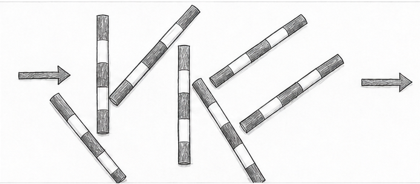
Figure of 8/ Weaves
Figure of 8 exercises are often used for horses who struggle with straightness or have weakness or asymmetry in the forelimbs. This exercise helps to increase the load placed on one limb for a period of time before transferring that load to the other limb. When completed symmetrically, this can help to improve muscle symmetry between the right and left sides.
Research has indicated that this exercise can help with motor control, improving balance during movement, awareness of limb placement, core activation and coordination. These benefits come from the exercise continually changing the horse’s direction, which alters the centre of mass and encourages the core muscles to activate to help support the body. As the horse steps underneath itself to support its body weight, it must coordinate the movement of its limbs while receiving feedback about where its joints and muscles are in space. This helps to enhance neuromuscular feedback, coordination and strength (Paulekas and Haussler, 2009).
Within rehabilitation programmes, figure of 8 exercises can therefore help to improve a horse’s balance and posture while developing the pathways involved in coordination. This can be particularly useful for horses with neurological or spinal conditions, reduced core strength or forelimb conditions (Paulekas and Haussler, 2009).

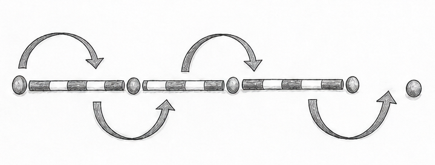
Hogs back
The hogs back is an advanced progression from figure of 8s and weaves. It encourages the same lateral flexibility through the spine, which in turn recruits the core and spinal stabiliser muscles to help maintain postural stability. Additional benefits include improving hindlimb flexion and muscular activation, helping to promote increased range of motion and hindlimb stability.
The main muscle groups targeted during this exercise include the abdominal core muscles, hamstrings and quadriceps. These are all important areas to target in many equine rehabilitation and conditioning programmes.
This exercise can easily be progressed by raising one side of the poles or making the weaves tighter. Both progressions increase the challenge, encouraging greater hindlimb flexion and lateral spinal flexibility.
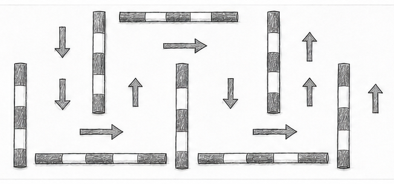
labyrinth
This is one of my favourite exercises because of how versatile it is. By setting up this one exercise, it can be used for its intended purpose, as a normal ground pole exercise, to guide backing up, or even as scatter poles!
When used for its intended purpose, as shown in the image to the right, the exercise encourages the horse to laterally bend around the corners. This promotes pelvic engagement and flexibility, helping to improve overall suppleness. This can be particularly beneficial for dressage horses, where suppleness and controlled movement are important.
The main muscles targeted include the abdominal core muscles, spinal stabilisers, gluteals, quadriceps and triceps. These are all areas that are commonly targeted within equine rehabilitation programmes.
This exercise can easily be progressed by making the turns tighter, which increases the challenge and encourages further pelvic engagement and lateral flexibility.
Star Poles
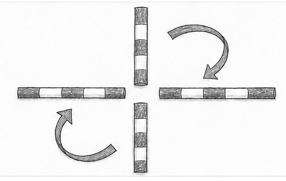
Star poles have many of the same benefits as ground poles; however, they also increase the load placed on the inside limb, while encouraging a longer stride length with the outside limbs. As the horse works around a circle, they are also required to bend their spine laterally. This encourages activation of the core and spinal stabilisers to help maintain postural stability.
The increased load placed on the inside limb can also target muscles such as the biceps and quadriceps, which can be an area of weakness in some horses.
Research specifically investigating star poles is limited. However, one source suggests that star poles can encourage a longer stride length and increased hindlimb flexion. The increased load placed on the inside limb may also help to encourage tracking up and build muscle mass within the forelimbs and thoracic sling (Ridgway and Harman, 1999).
It is important that this exercise is completed on both reins during a session. This ensures that the muscular demands placed on one side of the body are also placed on the other, helping to promote symmetrical muscle development from right to left.
We should always start by working on the largest circle and gradually progress towards working closer to the centre of the poles. As the horse becomes stronger and more confident, the exercise can be progressed further by raising the centre of the poles to provide an additional challenge and further increase range of motion.
This is a very challenging exercise and is often more appropriate for strength and conditioning rather than rehabilitation. If a horse is unable to successfully complete standard ground poles or maintain a balanced circle, star poles should not yet be introduced.
To Conclude
Pole work exercises can be tailored to suit a wide range of rehabilitation and strength and conditioning programmes. They provide holistic benefits to the whole body, encouraging core activation and increased joint range of motion, while helping to promote a longer, more elongated stride length.
Pole exercises can also be adapted and progressed to incorporate additional benefits, such as lateral spinal flexibility, improved coordination and pelvic engagement. This versatility makes pole work a valuable tool for both rehabilitation and general strength and conditioning.
As with any exercise programme, it is important to seek advice from a qualified veterinary physiotherapist to ensure that the exercises you are completing are appropriate and beneficial for your horse as an individual.
References
Bromiley, Mary. Equine Injury, Therapy and Rehabilitation, John Wiley & Sons, Incorporated, 2007. ProQuest Ebook Central, https://ebookcentral.proquest.com/lib/harperadams/detail.action?docID=351113.
Paulekas, R. and Haussler, K.K., 2009. Principles and practice of therapeutic exercise for horses. Journal of equine veterinary science, 29(12), pp.870-893.
Ridgway, K. and Harman, J., 1999. Equine back rehabilitation. Veterinary Clinics of North America: Equine Practice, 15(1), pp.263-280.
Shaw, K., Ursini, T., Levine, D., Richards, J. and Adair, S., 2021. The effect of ground poles and elastic resistance bands on longissimus dorsi and rectus abdominus muscle activity during equine walk and trot. Journal of Equine Veterinary Science, 107, p.103772.
Walker, V.A., Tranquillle, C.A., MacKechnie-Guire, R., Spear, J., Newton, R. and Murray, R.C., 2022. Effect of ground and raised poles on kinematics of the walk. Journal of Equine Veterinary Science, 115, p.104005.
Add comment
Comments