During my professional practice, I understand the time commitment required to carry out your horse's remedial exercises. Therefore, in some cases, exercises that can be carried out in the comfort of your horse's stable can be very beneficial for busy schedules.
Sometimes, the small movements that we influence by conducting in-stable exercises can feel a little pointless. However, sometimes the smallest movements, when repeated, can make the biggest difference!
These exercises can be beneficial for horses ranging from those on box rest to those who are fit and healthy but have some slight muscle asymmetries. However, you should always follow professional veterinary physiotherapy advice before completing these exercises to ensure they are the correct thing to do for your horse.
Weight Shifting
Weight shifting exercises are as simple as the name suggests! They encourage your horse to place more weight onto specific limbs or quarters, helping to promote a more even distribution of weight across all four limbs. This can be particularly useful for encouraging loading of a previously injured limb or increasing the amount of weight placed through a limb that may be weaker due to compensatory movement patterns.
Weight shifting can also help target specific muscles, encouraging them to work and contract without requiring the joints to actively move. This is known as an isometric muscle contraction (Dyke, 2014). Weight shifting can promote early mobilisation of the joints and muscles, helping to encourage muscle development and improve the strength and load-bearing capacity of previously weaker muscles (King and Colla, 2025).
These exercises can be performed in several different ways, depending on the desired outcome. They can be used to increase weight-bearing through the forelimbs, increase loading through the hindlimbs, or encourage a more even distribution of weight between either the forelimbs or hindlimbs.
Cranial Weight Shifting
Weight shifting is an exercise that can help improve flexibility, stimulate proprioception (limb awareness) and strengthen the core muscles, helping to support good posture and balance (Haussler, 2018).
This exercise aims to encourage the horse to place more weight through the forelimbs, helping to promote an even distribution of weight and gently load previously injured or weaker tissues. The muscles involved include the pectoral muscles between the forelimbs, the biceps brachii, which helps with elbow movement, and the core muscles, which work to help maintain balance and stability.
This exercise requires the horse to reach their nose forwards without moving their forelimbs, which can be quite tricky! My advice is to use the stable door as a gentle block to prevent the horse from stepping forwards, while using a lick to encourage them to reach their head forwards.
As this exercise requires the horse to actively reach their neck forwards, it can also be considered a baited stretch. This movement encourages a stretch through the muscles along the back, brachiocephalic muscles , which run along the neck and poll musculature.
Caudal Weight Shifting
A caudal weight shift aims to move the horse’s centre of mass towards the hindlimbs, increasing the amount of weight they are required to support. This encourages the muscles involved in pelvic stability and movement of the hip, knee (stifle) and elbow to work. These muscles include the biceps femoris, triceps brachii and gluteal muscles (Clayton, 2016). Additional benefits include activating the muscles responsible for maintaining posture and pelvic stabilising muscles, such as the gluteus medius, biceps femoris and tensor fascia lata,to help improve limb stability and balance (Elosegui et al., 2024).
One of the most common ways to perform this exercise is by applying gentle backward pressure to the horse’s sternum (between the forelimbs). This encourages the horse to shift its weight towards the hindlimbs. Tail traction can also be used if the horse is comfortable with this, but it should always be performed with caution and appropriate guidance (Elosegui et al., 2024). To progress the exercise, gentle pressure can be applied to one forelimb. This encourages the horse to place more weight through the diagonal hindlimb, increasing the challenge to the muscles involved in stabilising and supporting that limb. This can particularly increase activation of the biceps femoris, commonly known as one of the hamstring muscles (Geoff, 2022).
Lateral Weight Shifting
The aim of this exercise is to encourage increased weight-bearing through a specific limb. When targeting the forelimbs, we can use an exercise called withers rocks.
To perform this exercise, place your hand gently on the top of the horse’s withers and apply a small amount of sideways pressure towards the limb you want to encourage them to load. The horse should respond by shifting their weight towards that limb.
The aim is to maintain this weight shift for around 10 seconds, while ensuring the horse remains comfortable and balanced throughout the exercise.
This exercise encourages increased loading through the forelimb and encourages the muscles involved in supporting and stabilising the limb to work. These include the triceps brachii, which helps extend the elbow, as well as the pectoral and deltoid muscles, which contribute to forelimb stability.
To target the hindlimbs we often use lateral tail pulls, which are discussed below.
Baited Stretches
Stretching is a useful method for helping to improve the available range of motion within a joint. It works by encouraging the muscles and surrounding soft tissues to lengthen, while gradually increasing their tolerance to being stretched (Frick, 2010).
Stretching can be particularly beneficial when the tissues are warm, such as following exercise or massage. Warm tissues have different viscoelastic properties, meaning they can be more compliant and able to lengthen under a given amount of force. This can help us achieve a greater range of motion while reducing the risk of overstretching cold, stiff tissues (Frick, 2010).
Baited stretches aren't just for horses undergoing rehabilitation! They can also be a useful addition to the exercise routine of horses competing at higher levels. When performed appropriately, stretching can help maintain muscle flexibility and joint mobility, supporting the horse's ability to move comfortably and efficiently. Post exercise stretching can also help reduce levels of lactic acid within the muscle which has the potential to reduce chances of muscle soreness post exercise (Frick, 2010).
An optimal hold time for a static stretch is generally around 10–30 seconds. However, stretches should always be introduced gradually, starting with a shorter hold time and increasing this as the horse becomes comfortable and familiar with the exercise. This allows the tissues to adapt to the stretch while helping to reduce the risk of discomfort or injury (Frick, 2010).
Stretches of any form should never be completed more than 3 times a week due to the risk of causing muscle strains and tears. Stretching routines should always be advised by your veterinary physiotherapist as incorrect form and repetitions can cause major harm to the horses!
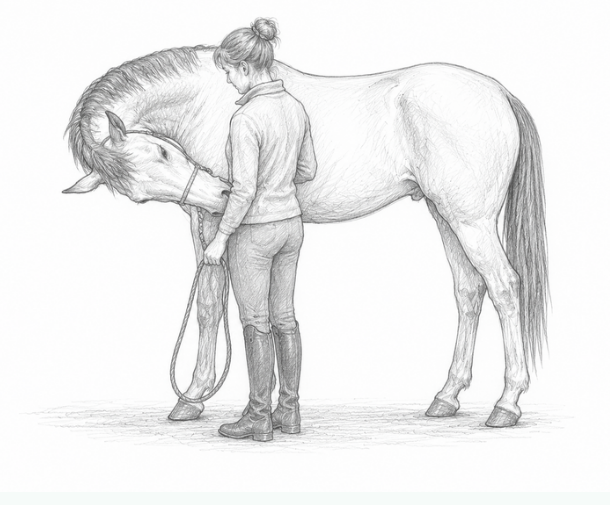
Lateral baited
A lateral baited stretch involves stretching the head and neck out to the side without the head twisting. The two ears should remain at the same height throughout the stretch (Clayton, 2016). The number of repetitions should be completed equally on both sides; however, the stretch may not be to the same degree on each side as a result of asymmetrical muscle tone (Clayton, 2016).
The aim of a lateral baited stretch is to stretch the neck muscles, including the brachiocephalic, the muscles around the poll and some of the muscles along the back, known as the epaxials. Certain variations of this stretch can also target muscles involved in forelimb movement, such as the triceps brachii.
There are several ways this exercise can be progressed. We start by aiming for chin to shoulder. Although this position provides a greater stretch around the poll, there is only a slight stretch through the neck muscles and limited stretch of the musculature along the back.
A progression is chin to girth level, followed by chin to flank. These positions increase the level of stretch within the neck and begin to stretch the muscles along the topline that are involved in spinal stability.
The most advanced form of this stretch is chin to hind fetlock. This involves a greater degree of spinal flexion and therefore maximally stretches the muscles along the neck and back. This position should always be gradually worked towards, ensuring the muscles have sufficient flexibility and elastic capacity to perform the movement comfortably.
To stretch forelimb muscles such as the triceps brachii, the horse should be encouraged to stretch their neck directly out to one side rather than rounding back towards their body. This helps to ensure the targeted muscles within the neck and top of the forelimb are being challenged, rather than placing greater emphasis on the muscles along the back.
Rounding
Rounding is one of my personal favourite stretches, as it helps to free up many of the muscles we typically associate with maintaining an optimal outline. Therefore, regular repetitions of this stretch target muscles along the back, known as the epaxials, the core musculature, muscles along the top of the neck, such as the rhomboideus, and the muscles around the poll (Clayton, 2016). If all of these targeted muscles have good flexibility, it provides the horse with the capacity to maintain an optimal posture, supporting both form and function and enhancing spinal stability.
We start by encouraging the chin to meet the chest (Clayton, 2016). This stretch places the poll in a highly stretched position, so it should always be introduced slowly and performed at the horse's own pace. A chin-to-chest stretch will target more of the neck muscles than the topline and core. However, in order to move into this position, the core must be activated to help maintain balance which in turn encourges lift through the topline, beginning to engage these muscles. (For a better understanding refer back to my other blog that discusses the bow and string theory)
Once a chin-to-chest stretch can be performed effectively, we can progress to chin between the knees (carpus) and eventually as far down as the fetlocks. As the degree of rounding increases, there is greater recruitment of the core musculature, which promotes lift and rounding through the back. It also helps to stretch muscles that can be prone to increased tone around the neck and poll, such as the brachiocephalicus. The more this exercise is performed, the greater the potential for improved flexibility of the core and topline musculature, supporting better posture and balance during ridden work and contributing to a more comfortable and functional outline.
This exercise can be particularly beneficial for horses with increased muscle tone and adhesions within their topline muscles. Increased muscle tone can reduce flexibility and may prevent the horse from effectively using these muscles to support spinal stability. Regular massage and appropriate rounding stretches may help to reduce tension within these tight muscle structures, improve flexibility and support overall posture and spinal stability.
For this reason, rounding stretches can also be beneficial when used at the appropriate stage of a kissing spines rehabilitation programme, alongside the wider rehabilitation plan.
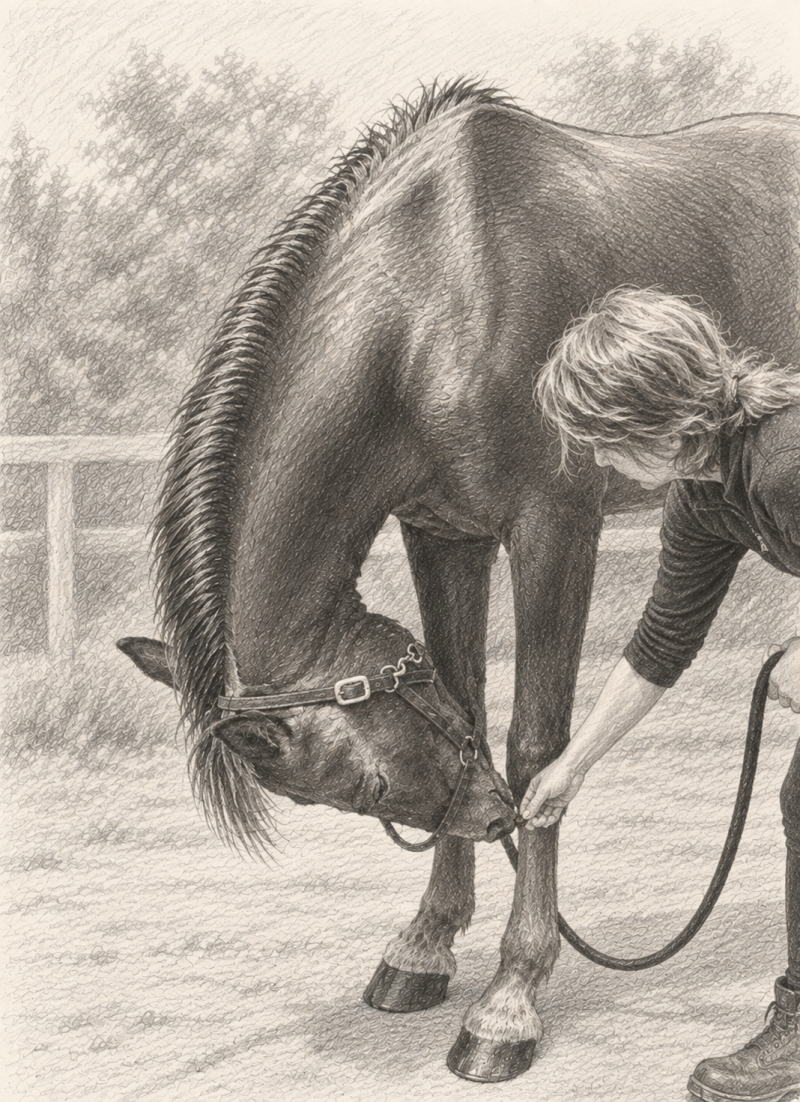
Cranial baited
Cranial baited stretches are performed in the same way as the cranial weight shift. However, when used as a stretch, the aim of this movement is to stretch the muscles along the topline, known as the epaxials.
When holding this position, the stretch can also target muscles along the neck, including the brachiocephalic, while helping to increase the space between individual vertebrae, known as the intervertebral space (Clayton, 2016).
This can make cranial baited stretches particularly beneficial for horses undergoing kissing spines rehabilitation, when introduced at the appropriate stage of their treatment and as part of an appropriate rehabilitation programme.
Sternal lifts
The overall aim of a sternal lift is to encourage a lowered head position as a result of active abdominal and forelimb muscle engagement (Haussler, 2018). This can easily be conducted by applying gentle upward pressure using your fingertips over the sternum, beginning between the pectorals and slowly moving backwards (Clayton, 2016). We aim for a 2 cm elevation of the withers to deem the exercise effective (Haussler, 2018), holding this position for 5–10 seconds (Waselau et al., 2008). Caution should always be taken to ensure this exercise is only conducted on warm muscles, such as post-exercise or post-massage, to ensure the muscles have the correct elastic capacity to fulfil the movement safely.
Benefits of conducting this exercise include increasing core strength, particularly through the rectus abdominis, as well as strengthening the muscles along the back that aid in spinal stability (Haussler, 2018). If this exercise is conducted while a horse is on box rest, it can help reduce the degree of muscle loss as a result of limited exercise. Maintaining strength during box rest can be beneficial as rehabilitation begins, as foundational muscle strength is still present.
However, if this exercise is not conducted correctly, it can cause significant discomfort for horses. Therefore, you should always follow the advice of your veterinary physiotherapist and only conduct this exercise if it has been specifically prescribed to you.
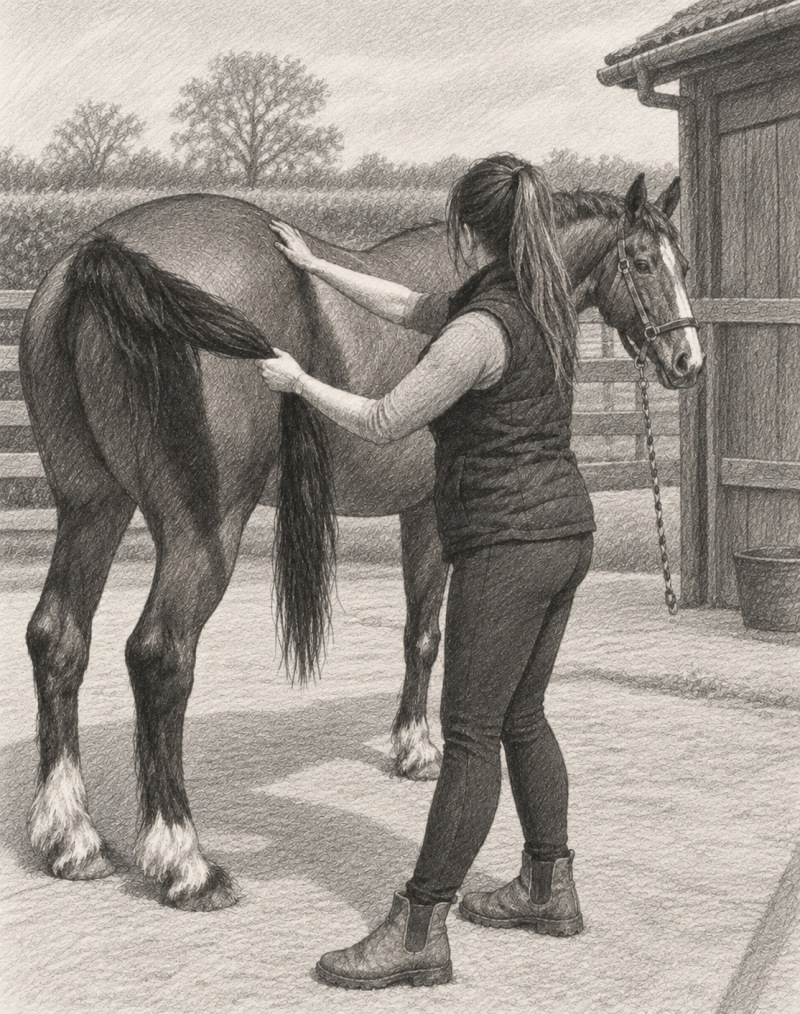
Lateral tail pulls
Lateral tail pulls are an exercise that I feel is very effective in practice and often prescribe to older horses that have lost muscle mass, or for those with upward fixation of the patella, where strengthening the quadriceps is going to greatly improve their condition.
To conduct this exercise, you should stand at the side of the horse’s hindquarters while holding their tail. Caution should always be taken to never wrap the tail around your hand, as this could potentially be dangerous. Once you are holding the tail, you should apply gentle pressure towards yourself, enough that the horse shifts their weight onto the limb closest to you, without actually taking a step. In some respects, this is a hindquarter lateral weight shift; however, I thought it deserved its own section.
By applying this lateral pressure, the pelvic stabilisers, including the biceps femoris (part of the hamstring group), are activated to help maintain balance. The muscles involved in the stifle and hip are also engaged to resist falling into the pressure (Clayton, 2016). By targeting the overall limb stabiliser muscles, over time this exercise can promote reduced laxity during movement, as well as increasing propulsion (Clayton, 2016).
This exercise should only be conducted after a veterinary physiotherapist has demonstrated the correct way to perform it, ensuring that the quadriceps are being appropriately activated and that no additional discomfort is being caused
References
Clayton, H.M., 2016. Core training and rehabilitation in horses. Veterinary Clinics: Equine Practice, 32(1), pp.49-71.
Dyke, J.V., 2014. Therapeutic exercise in veterinary rehabilitation.
Elósegui, M., Cediel, R., Goyaga-Elizalde, J. and Hernández-Fernández, T., 2024. Journal of Equine Rehabilitation. Journal of Equine Rehabilitation, 2, p.100013.
Frick, A., 2010. Stretching exercises for horses: are they effective?. Journal of equine veterinary science, 30(1), pp.50-59. help maintain back and neck ROM reducing muscle adhesions in brachiocephalic and epaxials Kaneps, A.J., 2016. Practical rehabilitation and physical therapy for the general equine practitioner. Veterinary clinics: Equine practice, 32(1), pp.167-180. DOI: https://doi.org/10.1016/j.cveq.2015.12.001
Goff, L., 2022. Therapeutic exercises for equine sacroiliac joint pain and dysfunction. Veterinary Clinics: Equine Practice, 38(3), pp.569-584.
Haussler, K.K., 2018. Equine manual therapies in sport horse practice. Vet Clin North Am Equine Pract, 34(2), pp.375-89.
King, M.R. and Colla, S., 2025. Therapeutic Exercises for Rehabilitation of Muscle Injury. Veterinary Clinics: Equine Practice.
Waselau, M., Sutter, W.W., Genovese, R.L. and Bertone, A.L., 2008. Intralesional injection of platelet-rich plasma followed by controlled exercise for treatment of midbody suspensory ligament desmitis in Standardbred
Create Your Own Website With Webador