The use of training aids in this industry is a very taboo subject. Some people love them, and some hate them. I wanted to write this peiece to explore what the aims of each training aid was and the potential drawbacks of them in general and when they are not used approriatly. The biggest question is how useful are they and could they potentially replace the need for a remedial exercise plan?
Side Reins
Side reins are commonly used during lunging, although they can also be used when a horse is being ridden. A side rein may be made entirely of leather or may include a section of bungee material to reduce the pressure applied to the horse’s mouth. They are usually used with a bridle or slip head, with one clip attached to the bit and the other attached to a roller, saddle, or girth.
The length of the reins is extremely important. If they are fitted too short, excessive pressure can be placed on both the mouth and the back where the roller is positioned. For this reason, they may not be appropriate for horses with conditions such as kissing spines.
The intended aim of side reins is to encourage the horse’s head towards the vertical, promoting engagement of the core musculature, lift through the back, and development of a rounded topline. They are often used in younger horses to help teach them to respond to rein pressure when ridden and can assist them in developing balance.
Drawbacks
In some cases, when side reins are fitted too short, the horse may appear to be working in a correct outline. However, some horses may not yet have the strength or muscle mass required to maintain this posture correctly, resulting in a false outline. In this situation, the horse may tuck the head in, sometimes moving behind the vertical, which can increase pressure on the poll and potentially contribute to increased muscle tension at the base of the neck.
The intended aim of side reins can be beneficial, but it is important to ensure that the horse has the appropriate balance and muscular development to maintain the outline being requested before this type of training is undertaken.
What does the research say?
A literature review assessing six studies reported several benefits of side reins, including providing consistent postural guidance and helping horses develop whole-body coordination through a more stable head and neck position. The review also concluded that side reins may be useful for short-term postural training when used appropriately. However, potential drawbacks were identified, including no significant increase in back muscle engagement and the possibility that side reins may act more as a mechanical restraint, restricting posture rather than enhancing spinal function (Siqueira and Figueiredo, 2026).
De Gogue
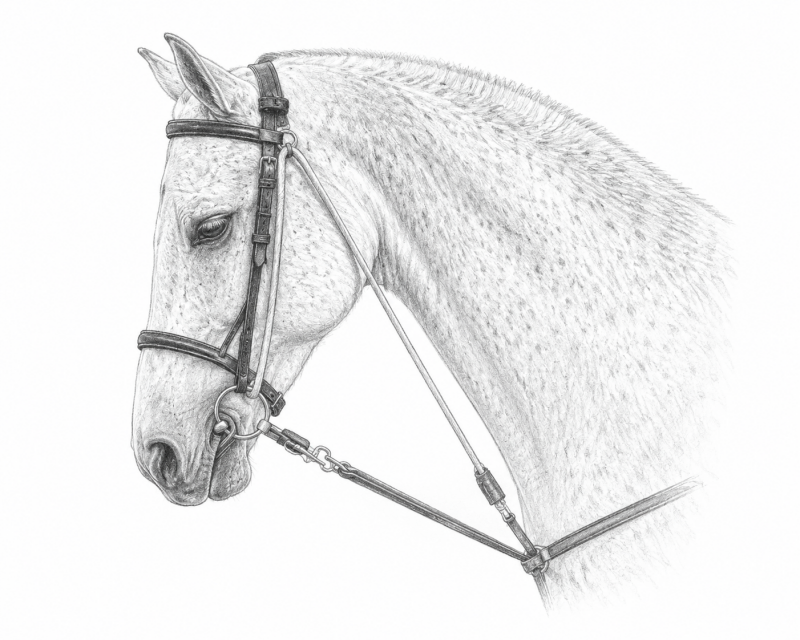
If the horse is unable to move in the way the training aid requires, pressure may be applied to the poll, which can be unsettling for some horses. In addition, because the De Gogue is made from relatively restrictive materials, it may contribute to the development of a false outline, similar to that seen with side reins, as the horse may adopt the easiest posture rather than one that is correctly supported by adequate muscle mass. Finally, by influencing head and neck position, the De Gogue can alter the horse’s natural movement and dynamic balance, which may lead to increased muscular tension if used regularly over time.
Therefore, when used appropriately in fit, healthy competition horses, this equipment may be beneficial for encouraging the horse to travel in a desired posture. In contrast, for horses undergoing rehabilitation or those with general weakness, a De Gogue may be less appropriate and other methods of strengthening and postural training may be preferable.
Pessoa
A Pessoa is a piece of equipment that connects the mouth to the hindlimbs with an additional attachment to a roller. The aim of this system is to encourage greater engagement from behind. It works through the roller positioned around the hindquarters, encouraging the horse to step further underneath itself and away from the stimulus. It should also encourage the horse to lower the head and neck and activate the core musculature, promoting lift through the back. Overall, the Pessoa is designed to encourage increased propulsion from the hindquarters to help support the horse’s body weight, allow a lowered head and neck position, and promote core activation to stabilise the spine.
Drawbacks
In some cases, a Pessoa can create restrictive movement. Some horses may dislike the sensation of the roller around the hindquarters and may shorten their stride length to avoid contact with it. A further issue arises because the mouth is connected to the hindlimbs; when the hindlimb retracts fully, tension may be transmitted to the mouth, which some horses find uncomfortable and may therefore avoid by reducing hindlimb movement. This is commonly seen when the Pessoa is fitted too tightly. Conversely, if it is fitted too loosely, it may drop below the hock and interfere with normal limb movement.
Overall, when fitted correctly, a Pessoa can be beneficial and may help guide the horse into a more appropriate outline without creating excessive pressure. Achieving the correct fit can be challenging, and poor fit may lead to additional problems, such as downward and inward pressure through the back and increased hamstring tension secondary to a shortened stride length.
What does the research say?
A recent study investigated whether a Pessoa system improves physical conditioning in adult horses. Eight horses completed 12 lunging sessions over a four-week period. The findings demonstrated improved symmetry of the back muscles compared with pre-treatment measurements, where asymmetry in muscle mass had been identified between the left and right sides. The researchers also reported improvements in horses that displayed curvature through the mid-back, suggesting that spinal stability may have improved following the training period (Siqueira et al., 2023).
Equi-Ami
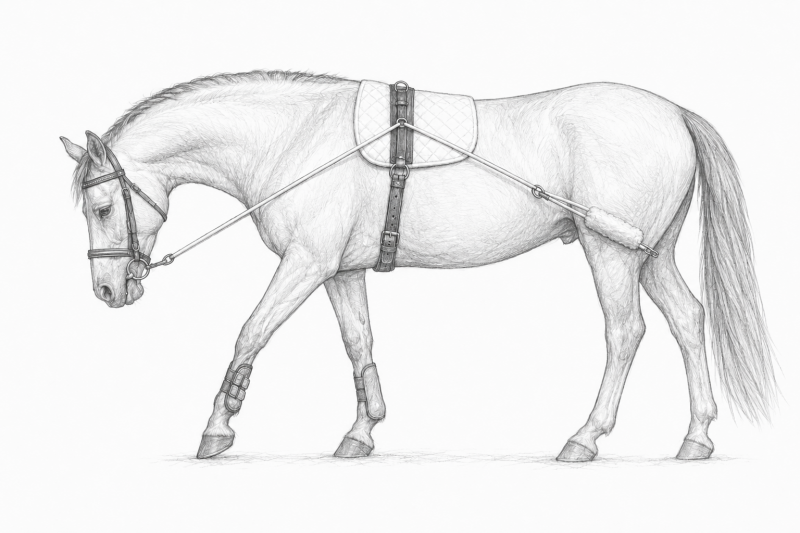
The Equi-Ami is based on a similar concept to the Pessoa, as it is designed to encourage increased propulsion from behind, which should in turn allow a lowered head and neck position and activation of the core musculature to promote lift through the back. The key difference is that the mouth is connected to the roller, while the hindquarter strap is also connected to the roller; the mouth and hindquarter strap are not connected directly to each other, reducing the risk of the hindlimbs pulling on the mouth.
The aim of training with this aid is to encourage a correct dorso-ventral muscle chain, in which the core muscles support the horse and help maintain an appropriate posture and outline. Further potential benefits include promoting straightness, which may make it useful for some younger horses, although it is generally not intended for excessive or prolonged use.
Drawbacks
When wearing an Equi-Ami, the horse is exposed to several pressure points, including under the abdomen at girth level, around the hamstrings where the hindquarter strap sits, and within the mouth. Consequently, incorrect fitting may cause considerable discomfort. Because both the forequarter and hindquarter attachments meet at the roller, pressure can be directed inward and downward onto the spinal column. This is the same area that we aim to encourage the horse to lift through, and in some cases this may contribute to the development of a false outline.
What does the research say?
One study investigated whether an Equi-Ami increases hindlimb engagement by measuring protraction and retraction angles, and whether it promotes lift through the back by assessing wither angles. The researchers found no significant differences in any of the measured angles or in stride length. Considerable variability was observed between horses, with some individuals showing a shorter stride length while others demonstrated an increased stride length. The authors concluded that the effectiveness of this training aid appears to be highly dependent on the individual horse and emphasised the importance of developing an individualised treatment plan for each horse (Calzone et al., 2022).

Theraband
A TheraBand/Equicore concept involves two different resistance bands attached to a saddle pad: one band passes under the belly, sitting behind the girth, and the other passes around the hindquarters. The bands are made of elastic material, with the aim that the horse will push against the resistance, helping to build muscle through the increased resistance applied during normal movement.
A major benefit of this set-up is that there is no pressure applied to the head, meaning the head cannot be forced behind the vertical. Instead, pressure points are created at the level of the belly strap, which pushes upwards, and around the hindquarters, which applies gentle inward pressure. These pressure points act in the same direction that we want the horse to move, encouraging lift through the core, rounding through the back, and increased hindlimb propulsion. Therefore, this aid can be beneficial in a variety of rehabilitation programmes, particularly those focused on hindlimb strengthening.
Drawbacks
Unfortunately, we cannot explain to the horse that it should push against the resistance in order to gain strength. As a result, we may see a similar response to that observed with systems such as the Pessoa or Equi-Ami, where the horse feels the stimulus around the hindquarters and simply moves away from it by shortening its stride length. In addition, if the horse is worked in this set-up for prolonged periods, it may learn not to respond to external stimuli and become less responsive to proprioceptive input.
What does the research say?
The literature has reported several benefits of resistance bands, including evidence that they actively engage the core musculature and promote spinal stability (Shaw et al., 2021). Additional recruitment of hindquarter muscles has also been demonstrated (Pfau et al., 2017), including the hamstrings and quadriceps. Therefore, there is scientific evidence to suggest that resistance-band set-ups can achieve many of their intended outcomes, particularly increased core activation and greater engagement of the hindquarter musculature.
Conclusion
To conclude, the theory behind many training aids is very appealing. They can be useful tools to help us communicate to the horse how we would like it to move and, overall, they can give us a greater degree of control over movement. However, before any training aid is used, it is essential that we are fully educated on how it should be fitted so that it is not applied too tightly and does not create excessive movement restriction.
As a physiotherapist, I am not completely against the use of training aids; as discussed, they can all have a role in certain situations. That said, I strongly believe that an appropriate remedial exercise programme designed to improve the horse’s overall strength and muscle mass is often a better long-term approach, as it helps the horse support itself more effectively.
Building strength in any animal is not a quick process, and it can be frustrating when setbacks occur. However, something a lecturer once said to me has always stayed with me:
“Always look for the two seconds of good in the ten minutes of bad, because that two seconds is still progress.”
Progress may take time, and in some cases a training aid may form part of the journey, but my aim is always to help you and your horse work towards your goals in the safest and most effective way possible.
References
Pfau, T., Simons, V., Rombach, N., Stubbs, N. and Weller, R., 2017. Effect of a 4‐week elastic resistance band training regimen on back kinematics in horses trotting in‐hand and on the lunge. Equine veterinary journal, 49(6), pp.829-835.
Shaw, K., Ursini, T., Levine, D., Richards, J. and Adair, S., 2021. The effect of ground poles and elastic resistance bands on longissimus dorsi and rectus abdominus muscle activity during equine walk and trot. Journal of Equine Veterinary Science, 107, p.103772.
Siqueira, R.F. and Figueiredo, I.M., 2026. Biomechanical effects of equine training aids: A systematic review. Equine Veterinary Education.
Siqueira, R.F., Teixeira, M.S., Perez, F.P. and Gulart, L.S., 2023. Effect of lunging exercise program with Pessoa training aid on cardiac physical conditioning predictors in adult horses. Arquivo Brasileiro de Medicina Veterinária e Zootecnia, 75(4), pp.545-553.
Add comment
Comments