As a veterinary physiotherapist, I work as part of a multidisciplinary team. This means there are several para-professionals who all work together with the main aim of enhancing animal welfare and wellbeing. Within this team we have members such as RCVS-regulated veterinary surgeons, who help to diagnose conditions and illnesses, with the support of RCVS-regulated veterinary nurses. Additional members include equine dentists, registered farriers, and equine nutritionists.
One member of this team that I feel is more important than they often receive recognition for is the equine hydro-therapist. Whether this is through swimming horses or the use of underwater treadmills, their role in your horse’s performance is far more beneficial than many people realise. During my time working as an equine hydrotherapy assistant, I saw many horses from a variety of backgrounds and disciplines, and it was incredibly rewarding to see how much progress they could make in as little as six weeks.
Due to these facilities not being mobile, it can put some people off. With our busy lives and schedules, it is often difficult to fit everything into a single week. However, I wanted to evaluate the true benefits of the underwater treadmill and explain how it can aid performance alongside a quality remedial exercise plan prescribed by your physiotherapist.
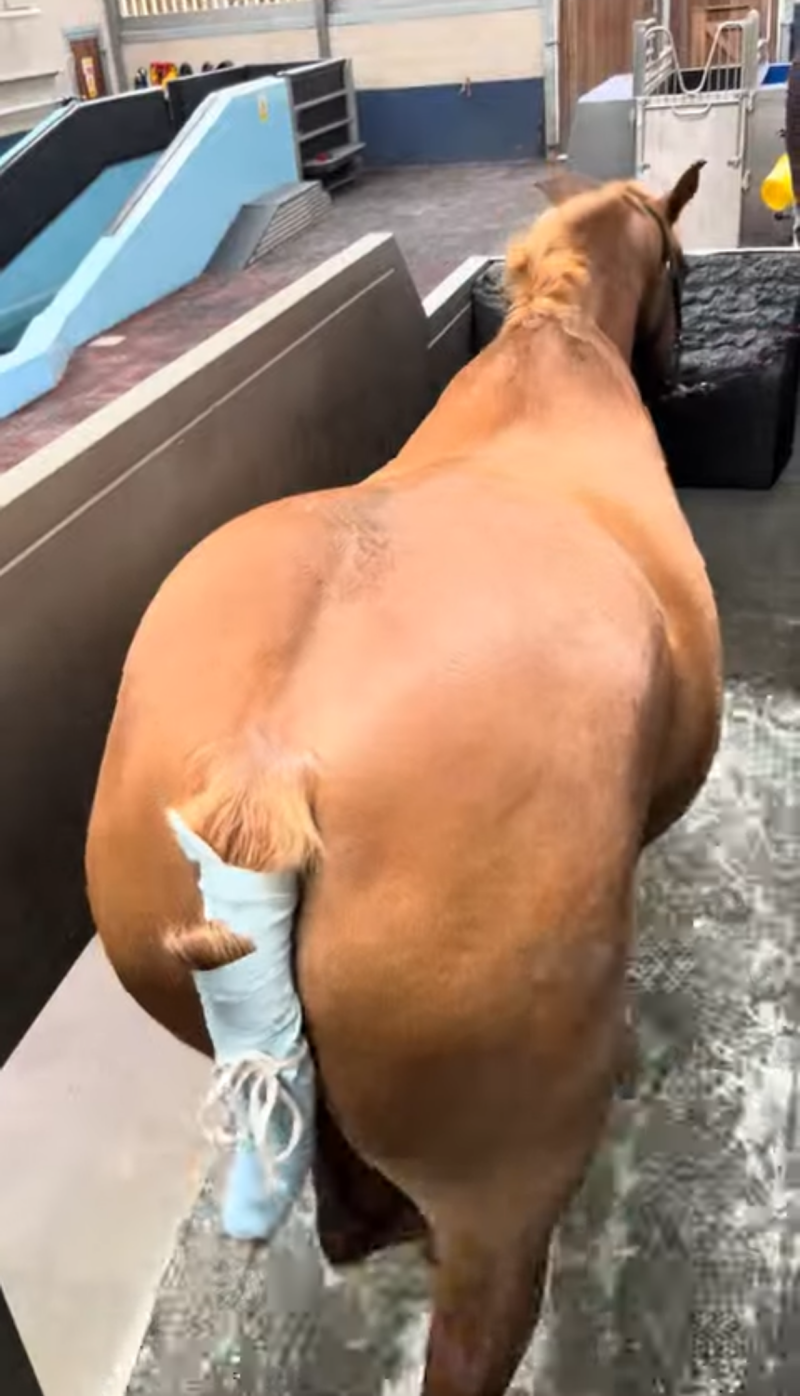
The benefits of an underwater treadmill come from the unique physical properties of water and how they act on the horse’s body. Water is much more viscous than air, meaning it creates greater drag and resistance as the horse moves through it. This added resistance can help improve muscle strength and conditioning. Water also provides hydrostatic pressure, which is the pressure exerted by the water on the limbs. As the limb moves deeper into the water, this pressure increases and can help support circulation and lymphatic drainage, particularly in the lower limbs where blood supply is often more limited. In addition, using cool water can help reduce inflammation and discomfort within the lower limb (Munoz et al., 2019).
Because water is denser than air, moving through it requires more effort. Even at a walk, the horse must recruit additional muscles to move its limbs through the water, which can help improve muscle strength and oxidative capacity (Frishman, Borgia and Valberg, 2015).
An underwater treadmill provides a highly controlled environment, allowing horses to work in a straight line and helping to improve muscle symmetry, straightness, and postural strength (Arnold, 2019). The moving treadmill belt makes it much harder for a horse to consistently favour one limb. As one limb is drawn backwards by the belt, the opposite limb must step through at the same speed, making it difficult for the horse to take a noticeably longer stride on one side and a shorter stride on the other. This encourages more even muscular effort between the left and right sides and can help improve muscle symmetry over time (Nankervis, Launder and Murray, 2017).
Working on an underwater treadmill also challenges the horse’s balance and postural control. To remain stable, the horse must engage its abdominal and core muscles, which contribute to postural and spinal stability. These are often important targets during rehabilitation programmes (Zsoldos et al., 2010). Research has shown that exercising on a 4% incline with water at mid-cannon height led to increases in topline muscle mass after just two sessions per week (Fair, Blake and Blake, 2023).
A study involving six horses found that increasing water depth increased movement through the spine, as well as forelimb and hindlimb retraction. Carpal (knee) flexion increased, while hindlimb fetlock extension decreased. The researchers also observed that, beyond a certain depth, the horses’ pelvises began to roll from side to side, suggesting that the limbs had reached their comfortable movement limit and the horses were beginning to compensate elsewhere in the body. They also noted that the increase in flexion eventually reached a plateau, and that the optimal water depth differed between individual horses (Tranquille et al., 2022).
Research has consistently shown that water depth has a major influence on stride length, stride frequency, joint range of motion, and limb protraction and retraction. The forelimbs and hindlimbs also respond differently to changes in water depth because they have different functional roles during movement (Munoz et al., 2019).
This highlights an important point: deeper water is not always better. If a horse works in water that is too deep, it may begin to move in a less desirable way, which is why assessment and monitoring by a qualified hydrotherapist is so important.
When used appropriately, an underwater treadmill can be a valuable tool for rehabilitation, muscle development, improving symmetry, enhancing core strength, and supporting horses returning to work after injury.
Research into underwater treadmills is still developing, as this is a relatively new area of equine rehabilitation and conditioning. However, current evidence suggests that aquatic exercise can improve postural stability and core strength, making it a valuable addition to many strength and conditioning programmes as well as rehabilitation plans.
Event horses, in particular, may benefit from underwater treadmill work. Improved core strength can help them support their body more effectively during the demanding lateral movements required in dressage, while increased strength and coordination may also assist with lifting the limbs during jumping and cross-country work. Another advantage is that underwater treadmill exercise can be used as a form of cross-training, providing variety within a horse’s workload. This may be especially beneficial for dressage horses when incorporated regularly, such as once a week (Nankervis et al., 2021).
Research has also reported benefits for horses with conditions such as kissing spines, osteoarthritis, tendon injuries, and those requiring reconditioning after a period of reduced exercise. The buoyancy of water helps reduce concussion forces through vulnerable joints and soft tissues, while the resistance created by the water encourages greater muscular effort. This allows horses to work harder through their muscles without placing the same level of cardiovascular strain on the body as comparable exercise on land (Mad Barn, 2026 and Munoz at al., 2019).
As with any rehabilitation or conditioning programme, underwater treadmill exercise should be tailored to the individual horse, taking into account its age, fitness level, discipline, and any underlying injuries or medical conditions.
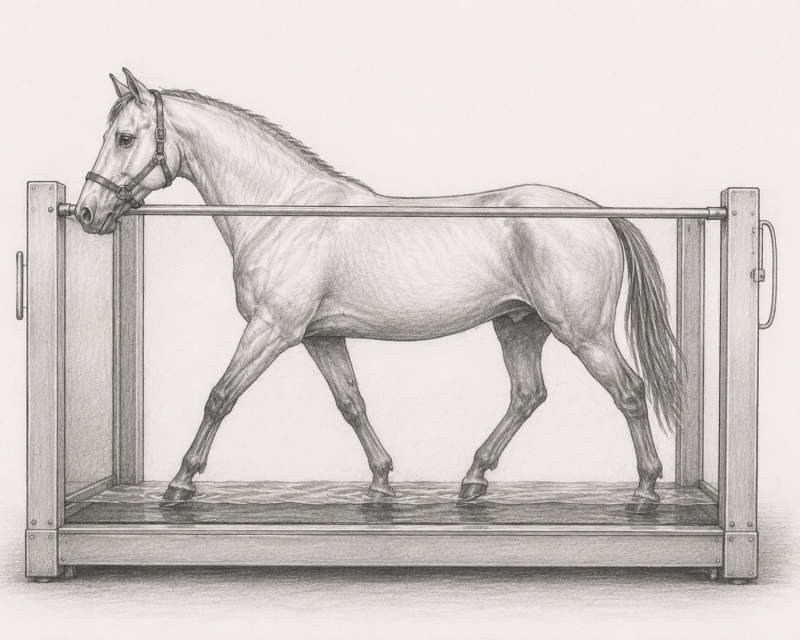
The main condition in which an underwater treadmill is not recommended is a tear of the superficial digital flexor tendon (SDFT). Walking in water changes the way the front leg swings through, meaning the horse must use additional muscles around the base of the neck and shoulder. This may place extra strain on the healing tendon, so underwater treadmill exercise is generally avoided during the early stages of an SDFT injury (Muñoz et al., 2019).
In conclusion, the underwater treadmill can be a very beneficial strength and conditioning tool for many horses. It may help improve muscle strength, support horses with back problems, and assist those with chronic arthritis by encouraging muscle development and helping to support vulnerable structures. These benefits are most likely when the water depth is set appropriately for the individual horse and its condition. For this reason, underwater treadmill therapy should always be carried out under the guidance of a suitably qualified rehabilitation or veterinary professional.
References
Arnold, E.J., 2019. Workload and kinematics of horses during underwater treadmill exercise (Master's thesis, Middle Tennessee State University).
Fair, N., Blake, S. and Blake, R., 2023. Four Weeks of Incline Water Treadmill Exercise Can Contribute to Increase Epaxial Muscle Profile in Horses. Veterinary Medicine International, 2023(1), p.9090406.
Firshman, A.M., Borgia, L.A. and Valberg, S.J., 2015. Effects of training at a walk on conventional and underwater treadmills on fiber properties and metabolic responses of superficial digital flexor and gluteal muscles to high-speed exercise in horses. American journal of veterinary research, 76(12), pp.1058-1065.
Mad Barn (2026) Underwater treadmills for horses. Available at: Equine Underwater Treadmills: Low-Impact Exercise for Performance & Rehabilitation | Mad Barn (assessed 12/8/2026)
Muñoz, A., Saitua, A., Becero, M., Riber, C., Satué, K., de Medina, A.S., Argüelles, D. and Castejón-Riber, C., 2019. The use of the water treadmill for the rehabilitation of musculoskeletal injuries in the sport horse. Journal of veterinary research, 63(3), pp.439-445.
Nankervis, K.J., Launder, E.J. and Murray, R.C., 2017. The use of treadmills within the rehabilitation of horses. Journal of Equine Veterinary Science, 53, pp.108-115.
Nankervis, K., Tranquille, C., McCrae, P., York, J., Lashley, M., Baumann, M., King, M., Sykes, E., Lambourn, J., Miskimmin, K.A. and Allen, D., 2021. Consensus for the general use of equine water treadmills for healthy horses. Animals, 11(2), p.305.
Tranquille, C., Tacey, J., Walker, V., Mackechnie-Guire, R., Ellis, J., Nankervis, K., Newton, R. and Murray, R., 2022. Effect of Water Depth on Limb and Back Kinematics in Horses Walking on a Water Treadmill. Journal of equine veterinary science, 115, p.104025.
Zsoldos, R.R., Kotschwar, A., Kotschwar, A.B., Rodriguez, C.P., Peham, C. and Licka, T., 2010. Activity of the equine rectus abdominis and oblique external abdominal muscles measured by surface EMG during walk and trot on the treadmill. Equine Veterinary Journal, 42, pp.523-529.
Add comment
Comments